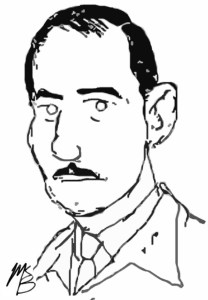
Lieutenant-Colonel P.H.W. Brind
2nd Battalion, Devonshire Regiment
At one stage got ourselves into the jungles which is extremely difficult to operate in. One of the first things you have to deal with are the wild animals. And it is interesting to note that we suffered I think more casualties from buffalo and rhinoceros charging than we did from the Mau Mau.
(IWM interview, 11 Jan 1988)
Born on 16 February 1912 in Mettingham, Suffolk, Peter Holmes Walter Brind was the son of General Sir John Edward Spencer Brind (1878–1954). He was educated at Royal Military College, Sandhurst and commissioned into the Dorsetshire Regiment in 1932. He was posted to India and became aide-de-camp to the governor of Bengal from 1936 until the eve of the Second World War. He was enroute to the United Kingdom when the war began, and subsequently joined the 2nd Battalion, Dorsets in France.
He was on leave in London when Germany attacked the Low Countries in May 1940 and immediately returned to duty in France. When he eventually rejoined the battalion, Brind recalled, “I had never been so shocked to see how weary and tired everybody appeared to be. I could talk to people and people would look at me and they’d blink their eyes and would start with an incoherent reply.”
He was wounded by mortar fire during the German invasion and evacuated through Dunkirk. Brind was later posted to the War Officer, attended staff college and by 1944 was commandant of a battle school. He was posted to Normandy three weeks after D-Day and assigned to the 1st Dorsets in the 50th Division as a replacement company commander. He was soon elevated to second-in-command during the breakdown at Falaise in August 1944.
In November, he succeeded Lieutenant-Colonel Sir John Carew Pole of the 2nd Battalion, Devonshire Regiment. While the 50th Division was to be withdrawn to England the next month, the 2nd Devons were transferred to the 131st Infantry Brigade in 7th Armoured Division. For his leadership during the final push into Germany, Brind received the D.S.O. His older brother Lieutenant-Colonel James Lindsay Brind commanded 5th Battalion, Wiltshire Regiment in North West Europe.
Following command of the battalion in the occupation of Germany, he was assigned to Palestine as a staff officer from 1947 to 1948. During the Mau Mau Emergency in 1954 to 1956, Brind commanded the 5th Battalion, King’s African Rifles in Kenya. At the time of this appointment, he had been unaware that the CO had been removed, a major had been charged with murder, and a platoon had also been detained for excessive violence. Although he quickly admired the abilities of his African troops as soldiers, his opinions certainly reflected a colonial mindset of the late-stage British Empire. “They had a tremendous admiration for the white man,” he recalled of his troops, “I always felt, this is never perpetuated later on, they looked to the white man as rather like their god who taught them everything … they had infinite trust in the white man.”
Following the Mau Mau rebellion, Brind served on the headquarters staff of Middle East Command and then chief of staff of Northern Command in the UK. He retired from the army as a major-general in 1967.
Brind died on 12 May 1999 in Haslemere, Surrey.
 World War Graphic History