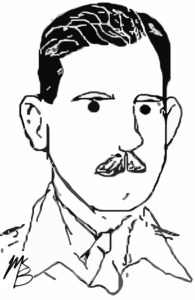
Lieutenant-Colonel C.A.R. Nevill
2nd Battalion, Devonshire Regiment
The landing craft grounded amid a certain amount of mortar and rifle fire. The ramps were let down, and we jumped into 4 1/2 feet of water. It was very wet, very cold. However, it had its funny side. The bed of the beach was very uneven, presumably as a result of shelling. Wading through the deep and rough water became a task of the first magnitude and, curiously enough led to a good deal of laughter. Then we were ashore directly in front of a German pill-box; the gun had fortunately been knocked out, and a number of German soldiers lay dead beside it.
(Nevill, “We Landed on D-Day: The Story of the 2nd Battalion the Devonshire Regiment”)
Born on 14 July 1907 in Bordon, Hampshire, Cosmo Alexander Richard Nevill was commissioned with the Royal Fusiliers (City of London Regiment) after graduating from Royal Military College, Sandhurst in 1927. He transferred to the 1st Battalion in India in 1934 and by 1941 had been promoted to lieutenant-colonel on the staff of General Archibald Wavell, commander-in-chief, India. Neville was made Officer of the Most Excellent Order of the British Empire in the King’s 1944 New Year Honours.
In March 1944, Nevill was appointed commanding officer of the 2nd Battalion, Devonshire Regiment, which was stationed in the United Kingdom as part of 50th Division preparing for the invasion of France. On 6 June 1944, Nevill recalled, “The sea was definitely rough and in the LCAs the troops were very sick, in spite of pills which were supposed to be infallible … The excitement grew, and as we were passing the line of bombardment ships, our rocket landing craft let loose their rockets. The noise of their explosions rolled across the water like thunder.”
Of his personal experience of the landing, Nevill wrote:
The CO landed in the Dorsets area. This shook him, as of course he should have landed in the Hampshires area. There were no signs of either of the leading companies, so he and his Intelligence Officer, Captain Bill Wood, turned right and walked along the beach towards Le Hamel. A number of tanks were knocked out on the beach, a flail had got about 20 yards through a. minefield, but its track had come off. There was a considerable noise of rifle fire from Le Hamel, and an occasional anti-tank gun opened up. He found the CO of the Hampshires, wounded, lying on the sand, trying to direct an attack on Le Hamel but up till that time no way inland had been found through the minefield.
For “gallant leadership, inspiration and disregard for his own safety,” Nevill received the D.S.O. for conduct on D-Day and in subsequent fighting. “Contrary to expectation,” Nevill later wrote, “our casualties had on the whole been light. Two officers and twenty other ranks had been killed, while six officers sixty other ranks had been wounded. A certain number were inevitably missing, owing to the disorganisation after landing, but we expected that the majority would re-join on the following day.” Nevill was wounded by shell fire on 12 July 1944 and evacuated. He was replaced by Lieutenant-Colonel Sir J.G. Carew Pole days later.
After the war, Nevill joined the general staff for the Military Staff Committee at the United Nations in New York. In 1950, he took command of the 1st Battalion, Royal Fusiliers in Berlin. He was promoted to major-general in 1956 but retired four years later after a heart attack. He took up oil painting, and became noted for his landscape exhibitions.
He died on 19 September 2002 at the age of ninety-five.
 World War Graphic History