Lieutenant-Colonel G.L. Wood
6th Battalion, Durham Light Infantry
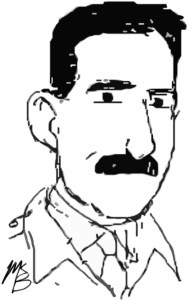
The 6th Battalion has built up during the course of this War a very fine reputation, second to none in the British Army. It has taken part in many Battles—it has never failed to gain its objective or in any other task which it has been given. This is a very fine record.
A Battalion is judged by the behaviour and achievements of the men in that Battalion. So it is with us and I would like each one of you to always bear in mind that you have played a great part in making this Battalion what it is …
(G.L. Wood, farewell message, Dec 1944, war diary)
Born on 15 November 1911 in Newcastle Upon Tyne, Northumberland, George Leslie Wood was a timber company representative and Territorial Army officer, commissioned with the Durham Light Infantry since 1933. He mobilized with the 9th Battalion and earned the Military Cross fighting a rearguard action in France in May 1940. He transferred to the 6th Battalion and served in the North African campaign, earning a Military Cross Bar for actions on 21 March 1943.
After advancing under heavy fire, Wood’s company needed to withdraw to the battalion position, which was soon subject to German and Italian assault: “All the time he showed the greatest coolness and efficiency under most severe M.G. and shell fire. During the second night the whole front was counter-attacked … There is no doubt that it was entirely due to this Officer’s coolness and daring that the left flank held and he showed the greatest courage throughout the whole operation.”
Wood served through the Sicily campaign as a company commander and became second-in-command in January 1944, as the battalion prepared for the invasion of France. On 5 June 1944, commanding officer Lieutenant-Colonel A.E. Green fell ill with malaria and Wood led the battalion when it went ashore with 50th Division. Green rejoined ten days after D-Day.
For his temporary tenure in command, he was awarded the D.S.O.: “Major Wood was always at the most threatened sector of his front encouraging his men and personally helping to locate the enemy tanks which were trying to work round the position. With complete disregard for his own safety and his fine powers of leadership were responsible for this vital position being held. until the arrival of Lieutenant-Colonel J.M. Hanmer before the end of the month.”
When Green was wounded on 10 September, Wood again became acting commanding officer but only until the arrival of Lieutenant-Colonel J.M. Hanmer before the end of the month. In November, Hanmer transferred to 4th Battalion, Royal Welch Fusiliers in the 53rd Division, and Wood became the official commander. The battalion and the 50th Division by this time, however, had been marked for withdrawal to the United Kingdom due to the reinforcement situation at the front.
After praising the achievements of the battalion, Wood announced:
Soon, many of you will be joining other Regiments for service. When you get there, remember that your behaviour, discipline and smart turn out will reflect on this Battalion. I know you will all do your best to ensure that your every action will reflect in a creditable manner on this Battalion.
Finally, I wish you to remember always that you were an integral part of the 6th Durham Light Infantry and not to forget your old Battalion.
After the war, Wood remained active in the Territorial Army and commanded the 8th Battalion, DLI from 1947 to 1950. In civilian life he was director a timer firm. He died on 1 September 1969 in Newcastle upon Tyne.
 World War Graphic History