Lieutenant-Colonel Humphrey Woods
9th Battalion, Durham Light Infantry
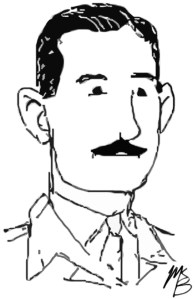
Humphrey said to me, ‘I haven’t said this to anybody else but I know I’m going to be killed when we get over to the other side … I feel it in my bones.’ Here’s a chap who’s been through it all, and been blown up on mines and everything else. But he somehow felt that he was going to be killed … supernatural or whatever you’d like to call it, he knew he’d come to the end … That was the epitome of courage, to know you’re going to be killed but go on.
(Maj-Gen. H.J. Mogg, interview, 28 Mar 1989)
Born in Lewes, Sussex, on 15 September 1915, Humphrey Reginald Woods joined the Kings Royal Rifle Corps as second lieutenant in 1936 after attending Royal Military College, Sandhurst. He served with 1st Battalion from Burma to the Middle East at the outbreak of the Second World War. He was twice wounded in North Africa and earned the Military Cross for gallantry in 1941. He earned a M.C. Bar for actions on 16 July 1942: “The determination of this officer to to engage the enemy more closely has been an inspiration to those fortunate enough to command him as well as those happy enough to serve under him.”
During the Second Battle of El Alamein, it was reported he had made a lone attack on a party of ten Germans armed only with his revolver. When a reconnaissance patrol was captured, he made a daring rescue in early November. Leading a depleted company forward, he destroyed several guns, killed fifteen Germans, and took another seventy-five prisoners. Woods received the D.S.O. for “dashing leadership [and] quick thinking.”
In July 1943, he took command of the 9th Battalion, Durham Light Infantry in Sicily. His predecessor Lieutenant-Colonel A.B.S. Clarke and the second-in-command had been killed by a shell. After the hard fight north from Catania to Messina to secure the island, the battalion along with the 50th Division returned to the United Kingdom where it prepared for the invasion of France. On D-Day, the battalion landed on Gold Beach as part of the second wave. On 14 June, Woods was ordered to capture the village of Lingèvres against a defending Panzer division.
Second-in-command Major Herbert Mogg recalled facing heaving enemy machine gun fire as they advanced: “I spoke to Humphrey Woods on my radio, and this is the last time I heard him, and he said “We are running into terrible trouble here on the left, all the ‘A’ Company officers are casualties. I am trying to get on with ‘B’ Company and I will try and see how it happens.”
Woods was killed by mortar fire shortly thereafter. Mogg recalled, “I suddenly realized that meant that I was the senior officer in the place and that made me the Commanding Officer, which filled me with utter despair to start with but I realized I must do something about it.”
 World War Graphic History