Lieutenant-Colonel Joss Percy
9th Battalion, Durham Light Infantry
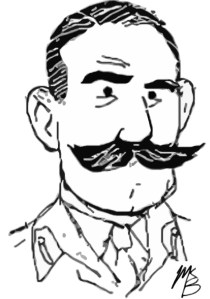
To my distaste now, Montgomery sacked Joss Percy. Joss Percy declined any other posting as said ‘I’m going home.’ On the way home on a troop ship, he died of a broken heart. And the Durhams who were there will always say, that was the loss of a very gallant battalion and brigade commander. Certainly, I blame Montgomery.
(William Henry Partridge, IWM interview, 20 Apr 2001)
Born in Western Australia, on 10 October 1897, Joscelyn Edward Seymour Percy served with the Durham Light Infantry during the First World War. He earned the Military Cross in 1917: “For conspicuous gallantry and devotion to duty. He led his men with great determination and himself killed two of the enemy. Later, although severely wounded, he remained in the enemy’s trenches until the last man of his party had withdrawn.” Twenty-three years later, Percy took command of the 9th Battalion, Durham Light Infantry during the battle of France in June 1940.
Describing the chaotic retreat toward Dunkirk, Percy wrote:
We marched along the road, very opened out and soon after starting the Germans put in the most spectacular air attack imaginable. It was so terrific as to suggest they were showing off and was rather like the air attack in H.G. Wells’s film Things to Come or more so. They put in 200-300 planes of all sorts and kept it up for an hour and a half while we walked slowly along the road. They were dropping salvoes of heavy and lighter stuff. The crescendo of sound was extraordinary and continuous with detonations and the scream of dive-bombers.
After evacuation from France, Percy instituted a strict training regime for his depleted battalion. As a result of a gunshot wound from the first war, he walked with a limp and a cane. One soldier, John Llewellyn Williams, said in the battalion the colonel was known as the “Black Prince”: “He had a very heavy black moustache and on occasions he was annoyed with us, it almost used to stand out from his face, like a straight edge. And he used to really push us around.”
As part of the 151st Infantry Brigade, 50th Division, the 9th DLI deployed to the Middle East in 1941, first to Egypt then Cyprus then to Palestine and next Iraq. By early 1942, the division had joined British Eighth Army in the Western Desert fighting the North Africa campaign. Battalion adjutant Eric Neville Hooper recalled of Percy, “I think he was a very good regimental officer, but I think his attitude was more or less the first war type of commanding officer, who believed in keeping strict discipline with the officers. I think too he was a little bit too old … We respected Colonel Percy. His bark really was worse than his bite.”
Following reshuffling of commands in the aftermath of Eighth Army’s defeat at the battle of Gazala in June 1942, Percy became commanding officer of 151st Brigade. Percy’s “great vigour and skill” and “high standard of personal leadership” earned him the Distinguished Service Order for command of the 9th DLI in the battalion. His posting as brigadier would prove less successful.
He was sacked in November due to his brigade’s perceived sluggish progress during the Second Battle of El Alamein. He was replaced by Brigadier Daniel Beak, a First World War Victoria Cross recipient. “I think honestly, it was too big for him,” Hooper said of Percy’s performance. “He was very, very nervous.” Following a rear posting in Egypt, Percy sailed for home. He died enroute on 8 August 1943.
“I could see how upset he was,” Hooper stated on bidding farewell to Percy after the brigadier’s removal. “It broke his heart really. Because he supposedly died on the way home to England. But afterwards learned what had happened was he committed suicide, on the way up, on the boat.”
 World War Graphic History