Lieutenant-Colonel Hugh Oldman
7th Battalion, Green Howards
8th Battalion, Durham Light Infantry
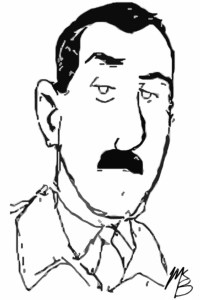
This morning the Sultan’s Defence Secretary and former Army Commander, Colonel Hugh Oldman, ex-Second World War, ex-Staff College, ex-NATO, told the official story of the coup which brought Qabus to power. Colonel Oldman modestly denied any knowledge of the coup. It was, he said, all done behind walls, kept within the family.
(The Guardian, 31 Jul 1970, 9)
Born on 24 June 1914 in Belgaum, British India, Hugh Richard Deare Oldman was a graduate of Royal Military College, Sandhurst, a cricket player and London Metropolitan Police constable from 1936 to 1937. He took an emergency wartime commission with the Royal Norfolk Regiment in 1940. He commanded a company of the 5th Battalion, The East Yorkshire Regiment in the North African theatre and earned the Military Cross at the Battle of Gazala in June 1942.
Oldman transferred to the 7th Battalion, Green Howards as second-in-command in June 1943. A year later, the unit landed in Normandy with the 50th Division on D-Day. During the first action, commanding officer Lieutenant-Colonel P.H. Richardson was taken prisoner. Oldman assumed temporary command until he reverted to 2 i/c on the arrival of Lieutenant-Colonel W.R. Cox before the end of the month.
On 16 August 1944, Oldman was given his own command when he succeeded Lieutenant-Colonel C.F. Hutchinson of the 8th Battalion, Durham Light Infantry, who had only days earlier replaced wounded Lieutenant-Colonel R.P. Lidwill. In recognition of his leadership through to the withdrawal of the 50th Division in December 1944, the French government award Oldman the Croix de Guerre (Palme). Postwar he was an instructor at Staff College, Camberley.
One of his subordinate officers, Lieutenant W.H. Jallard, remembered Oldman’s performance more negatively. “We had the misfortune to have a commanding officer at one stage, who I won’t mention his name, he’s dead now, but he was known as ‘Cellar Charlie” … because he’d always look for the deepest cellar. And he set up his headquarters in the cellar and he never appeared … He survived the war this particular lieutenant-colonel, he later achieved a knighthood. He went to Oman or something like that and had a glorious future. But I don’t think the men have ever forgotten him because he was a dreadful CO, terrible.”
From 1947 to 1951, Oldman was seconded to the Sudan Defence Force and then served on staff in Pakistan, where he played cricket. He was deputy commander of the Aden Protectorate Levies from 1959 to 1961, and commanded the Sultan’s Armed Forces (SAF) in Oman until 1964. He received the Order of the British Empire and retired from the army in 1967.
Oldman returned to Oman on being appointed military secretary in February 1970. To combat guerilla rebels in Dhofar he advised Sultan Said bin Taimur to increase the army’s size and increase soldier pay. By summer 1970, the British foreign office that Oman’s stability depended on a change in leadership. Oldman and other SAF officers in the Oman military coordinated a coup against the Sultan on 23 July, although British officer did not directly participate. When asked to step down peacefully, the Sultan shot and wounded on the coup plotters. He then accidently shot himself as he and his bodyguard attempted to escape. He sent a message to Oldman unaware his military secretary was one of the architects of the coups. With no option, the sultan abdicated to his son Qaboos bin Said.
“It was a most tear-jerking experience,” Oldman reported to the press when the coup was announced to the people of Oman three days later. “There was incredible happiness. There was overt joy and sheer jubilation. In fact, the Sultan had a great deal of difficult in getting everyone to go back to work.” The new 30-year-old sultan retained him as advisor and defence secretary until Oldman resigned in 1973. He received the Oman Order of Merit and was knighted in 1974.
He died in Saluda, Virginia on 26 November 1988.
 World War Graphic History