Lieutenant-Colonel Robin Hastings
6th Battalion, Green Howards
2nd Battalion, King’s Royal Rifle Corps
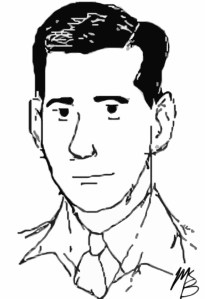
I want it to be clearly understood that I, who was there and saw it, have nothing but admiration for the way the Bn fought yesterday afternoon. The withdrawal was given entirely on my order, it was carried out perfectly, and it was given chiefly because of the threat of tanks to our Lines of Communication. The men of the Bn deserve more credit for their performance yesterday than for many other battles for which we will have received more credit.
(Quoted in 6th Green Howards war diary, 12 Jun 1944)
Born on 16 January 1917 in Rugby, Warwickshire, Robin Hood William Stewart Hastings was an horse racer, a graduate of Christ Church, Oxford University and a commissioned officer in the King’s Royal Rifle Corps since 1938. In response to press criticism about “undergraduate hooliganism,” in 1937 he wrote a joint letter with George Haig, 2nd Earl Haig, to the Daily Telegraph, “Whereas our father sowed their wild oats in the comparatively secluded company of dons and tutors, our audience is only limited by the circulation of the daily papers … The public gaze is misdirected. The foundations of the Empire are hardly likely to be shaken by the hail of stones.” Hastings’ and Haig’s letter went on to claim the Empire was “however, threatened by the words and actions of those undergraduates whose principal diversion is to pass treasonable motions,” presumably a reference to radical, Communist, or pacifist elements at the university.
During his final verbal examination at the university, Hastings recalled, “… the gentlemen listened politely and I imagined that they were deciding whether to give me either nothing or a fourth — that degree set aside for indolent sons of vice chancellors, relations of foreign royalty and those who have fallen on their heads in the last term. Imagine my surprise when I picked up The Times one day to see that I had a second class degree in Modern History and the totally useless entitlement to put BA after my name!”
He noted that if he had received a first class degree he might have pursued an academic career. A life he speculated that would be ”spent with my nose full of dust from the shelves of the Bodleian or walking along the two path with muffler and pipe, being surrounded by dons who waved the Red Flag in their left hand and demanded that the steward placed another glass of the ‘21 in their right hand.”
After completing his education, he transferred to the 2nd Battalion, The Rifle Brigade in India. “I knew so little about the army that I had not anticipated exile of this sort,” he later wrote. By 1940, in the North African theatre, he served as an intelligence officer for 7th Armoured Division and then GSO 2 during the Battle of El Alamein in October 1942. He earned the Military Cross and the notice of General Bernard Montgomery, who favoured young battalion commanders. At only twenty-six, Hastings took command of the 6th Battalion, Green Howards in the 50th Division during the Sicily campaign.
On 6 June 1944, the 50th Division went ashore at Gold Beach, with Hastings leading the 6th Green Howards. His D.S.O. citation read in part: “The Bn had a most difficult task to perform and its conspicuous success was very largely due to Lt Col Hastings’s detailed preparations before the landing and first class leadership afterwards.” Hastings is quoted in Christopher Dunphie’s Gold Beach as stating of the award that it was “quite undeserved personally, but probably par for the course for a battalion commander who survived D Day and whose battalion did quite well.”
During the failed assault through the bocage country around Tilly on 11 June 1944, the 6th Green Howards suffered 250 casualties. After calling off the advance, Hastings too responsibility for the order and reassured his depleted unit that it had fought well. At the end of the month, he suffered a shrapnel wound to the leg. He was replaced by Lieutenant-Colonel Roy Exham, former commanding officer of the 6th Duke of Wellingtons and ten years his senior.
Once Hastings recovered, in September 1944, he was assigned to command 2nd Battalion, King’s Royal Rifle Corps in the 4th Armoured Brigade. For his leadership, he earned the D.S.O. Bar: “Throughout the period he distinguished himself by his untiring energy, offensive spirit, persistent disregard for his own safety and great skill in handling his Bn.” He relinquished command in December due to ill-health, but the next month became GSO 1 for 11th Armoured Division.
After the war, he was an instructor at the Staff College, Camberley, although eager to resuming his riding career. “This is a job which usually results in grey hairs and nervous breakdowns rather than in riding winners,” he wrote of staff college. “But with the war only just over we had a pretty good knowledge of what a division consisted of and most of the early students were senior officers who had just missed a staff course.” He retired from the army in 1952.
He continued to race horses and joined the British Bloodstock Agency, serving as chairman for thirty years. He authored The Rifle Brigade, 1939-45, The London Rifle Brigade, 1919-50, a memoir Without Reserve Some Recollections of a Bloodstock Agent in 1987 and a posthumously published wartime diary An Undergraduate’s War in 1997.
Hastings died on 28 March 1990 in Bramdean, Hampshire.
 World War Graphic History