Lieutenant-Colonel Bobby Bray
2nd Battalion, Gloucestershire Regiment
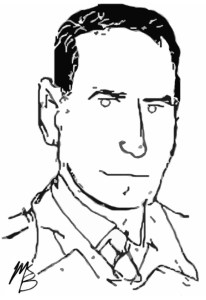
Lieutenant-Colonel Bray was in a glider that crashed badly on landing. Though bruised and badly shaken, Lieutenant-Colonel Bray made his way to Divisional HQ. On the way he sustained further injuries owing to a fall which resulted in concussion. As soon as he recovered consciousness he continued on. Though in great pain he set to work when he arrived in a way which inspired all around him.
(D.S.O. citation, 31 August 1944)
Born on 14 June 1908, Decca, Bengal Presidency, Robert Napier Hubert Campbell Bray was commissioned in the Duke of Wellington’s (West Riding) Regiment following graduation from Royal Military Academy, Woolwich in 1929. In 1942, he became GSO 1 for the newly formed 6th Airborne Division. As chief-of-staff to Major-General Richard Nelson Gale, Bray helped to design the airborne operations for the Normandy invasion.
His D.S.O. citation described his contribution after D-Day: “His judgement remained calm and reliable throughout. His cheerfulness and his strong sense of discipline inspired the whole headquarters and all others who came in contact with him.”
In early November, Bray took command of 2nd Battalion, Gloucestershire Regiment after Lieutenant-Colonel F.W.A. Butterworth was killed by enemy shelling. In January 1945, as acting commander for 56th Infantry Brigade, he earned the D.S.O. Bar
This was the first occasion on which Lt-Col Bray had ever commanded a bde and the whole operation was completely unexpected, yet he handled the situation with outstanding success. Due to his personal example and leadership as well as his competent conduct of the front under his comd the result of the operation was never in doubt from thee start.
Postwar, Bray advanced through several command and general staff appointments in the Middle East and Germany. In Korea after the armistice, he command 29th Infantry Brigade from 1953 to 1954. He was subsequently Director of Land/Air Warfare with the War Office, and held several later high commands. From 1963 to 1967, he was Commander in Chief Allied Forces Northern Europe and then Deputy Supreme Allied Commander Europe for NATO until the end of 1970.
After a forty-two-year army career, Bray retired in 1971. He died on 14 August 1983 in Warminster, London.
 World War Graphic History