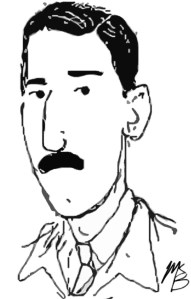
Lieutenant-Colonel P.H. Richardson
7th Battalion, Green Howards
2/6th Battalion, Queen’s Royal Regiment
For some reason I don’t know why neither B or D boys seem to possess any means of dealing with the tanks though the M10’s did knock out one and I think I got the commander of one myself with a Bren. We suffered quite a few casualties and bit by bit parties got put in the bag … If I had only had tanks myself or more PIATs things might have been different. I could have knocked out three tanks myself if I had only been carrying a PIAT at 30-50 yds range.
(Lt-Col. P.H. Richardson, 10 Aug 1944, war diary appendix)
Born on 23 July 1909 in British, India, Philip Herbert Richardson was a commissioned officer in the Queen’s Royal Regiment since 1930. Following prewar service in China and India, he attended Staff College, Camberley in 1941. Following a posting as brigade major, he served as second-in-command of the 2/5th Battalion, Queen’s Royal Regiment in North Africa, and next transferred to the 6th Battalion, Durham Light Infantry in Sicily.
As the 50th Division prepared to withdraw to the United Kingdom at the end of the Sicily campaign, Richardson assumed command of the 7th Battalion, Green Howards in August 1943. Ten months later, he led battalion ashore when it landed in Normandy on D-Day. As the battalion went forward, “we found no opposition, which seemed suspicious, as the Germans had been heavily entrenched there earlier in the day.” Suddenly a camouflaged tank fired on Richardson’s group, killing ten soldiers. As German troops closed in from all sides, Richardson was wounded and captured.
He was transferred from a German hospital to a POW camp on 18 June, where he and other prisoners set about an escape plan with a tunnel. While being transferred again to another camp on 5 July, Richardson and three other officers managed to jump off the moving transport train. They hid in the woods and travelled northwest until connecting with the French Resistance. They finally rejoined advancing British troops on 6 August.
Richardson reported of his month-long experience: “All the French helpers we saw were patriotic and refused to take money or food, but in general security was extremely poor among the Maquis and Resistance. I would advise Allied evaders and escapers to take their advice, but to tell them as little as possible about themselves, and to be prepared to operate independently at any moment.”
During his absence, Lieutenant-Colonel W.R. Cox had taken over the 7th Battalion, Green Howards in the Normandy campaign. Although awarded the Order of the British Empire for his escape, higher command evidently no longer trusted Richardson’s judgement to resume his original command. He was posted to Cario as assistant adjutant general from January to April 1945 before being given another chance at battalion command in Italy. As commanding officer of 2/6th Battalion, Queen’s Royal Regiment for the final month of the war he was awarded the D.S.O.:
His personal leadership and determination, coupled with his gallantry and initiative, inspired his battalion to a series of remarkable feats of arms in the face of stern opposition and intense fatigue …
With less resourceful and determined leadership these feats of arms could not have been carried out in the time or at such light cost in casualties. In the event these actions had decisive effects on the whole operations.
In June 1945, he was promoted to command 169th Infantry Brigade, and in late 1946 served as GSO 1 with the War Office. He commanded the 1st Battalion Royal Sussex Regiment in Egypt from 1950 to 1951, and the 160th (Welsh) Brigade from 1954 to 1957. He retired from the army in 1961.
Richardson died on 19 March 1994 in Lymington, Hampshire.
 World War Graphic History