Lieutenant-Colonel Cecil Firbank
2nd Battalion, Lincolnshire Regiment
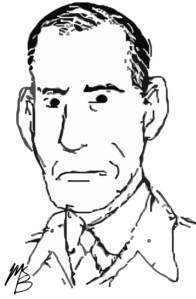
Despite the great destruction wrought by the atomic bomb, infantry has in no way been reduced to the role of an occupation force in any future major conflict. With each new weapon that has appeared down through the history warfare that have been some who have claimed that the knight in armor or the soldier with a rifle is no longer of use. But wars will be fought by infantry men as long as we have wars.
(Quoted in Montreal Star, 16 Nov 1955, 3)
Born in British India on 1 August 1911, Ronald Clarence Macdonald was a field hockey player educated at the Royal Military College, Sandhurst. In 1931 took a commission with the Royal Warkwickshire Regiment, which his father had earlier commanded. He attended staff college and following instructional duties, was assigned to the 1/6th Battalion, South Staffordshire Regiment.
The previous two commanding officers had been wounded, and Firbank took over in the middle of a battle. He proved an effective leader but one regarded by many of the men as a martinet. Although he had been post briefly to division headquarters, Firbank according to a solider “hated people in the rear areas, even as close as Bde HQ!!!” He earned the D.S.O. for actions on 14 October 1944:
Throughout this engagement and subsequently during the consolidation of the objective, Lt-Col Firbank set a fine example of leadership, coolness, and judgement whilst under intense fire, and was quite unmoved by casualties, which including the Bn Intelligence Officer who was killed at his side.
It was largely due to his personal example of courage and determination that the Bn was not stopped by the enemy defensive fire in front of the wood, and gained its objective, the capture of which was essential for the development of the Divisional Commander’s plan.
Five months later, Firbank received a D.S.O. Bar for the attack on Winnekendonk on 2 March 1945:
Col Firbank took hold of the situation. Under fire from snipers, with extreme coolness and great energy he selected 150 men and consolidated his gains, and in the morning cleared the town. In the morning a balance was struck. Lt Col Firbank’s command had taken close on 200 prisoners and had killed at least 50 more Germans. 3 of the 4 SP guns had been knocked out and both the 88’s were destroyed. The 2 Lincolns’ losses were six officers and 54 men. The magnificent success was due to the courage, calmness and energy of Col Firbank.
Major-General Lashmer Whistler of 3rd Division recorded: “The Lincolns under Cecil Firbank are probably the best battalion in the division.” The colonel was elevated to command of the 71st Infantry Brigade in the 53rd Division after the death of Brigadier Maxwell Elrington on 23 April 1945.
Postwar, Firbank was commandant of School of Infantry until 1952 and then commanding officer of the 43rd (Wessex) Division. He was later director of infantry for the British army and after a thirty-five-year career, he retired as a major-general in 1959. He remained connected with the military as honorary colonel of the North Somerset Yeomanry and the Somerset & Cornwall Light Infantry.
He died in August 1985 in Sherborne, Dorset.
 World War Graphic History