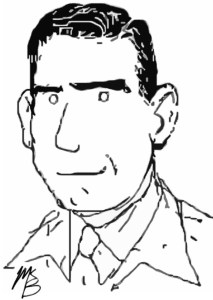
Lieutenant-Colonel Mike Halford
Hallamshire Battalion, York and Lancaster Regiment
The battalion did the work, and I got the DSO.
(Quoted in Daily Telegraph, 21 Jan 1999, 29)
Born on 28 October 1914 in Yateley, Hampshire, Michael Charles Kirkpatrick Halford was a graduate of Trinity College, Cambridge and commissioned in the York and Lancaster Regiment, which had been commanded by father and maternal grandfather. He served during the Arab Revolt in Palestine 1936 and became adjutant for the Hallamshire Battalion in 1939.
After the evacuation from Dunkirk, Halford completed staff college at Camberley. After a posting to brigade major for the 202nd Infantry Brigade and then GSO 2 for the junior staff college, he joined the 138th Infantry Brigade in North Africa in February 1943. He served a brigade major during the Sicily and Italian campaigns until March 1944 when he was assigned to the US Army staff college at Fort Leavenworth. He received the Order of the British Empire for his service in Italy: “His calm, unruffled manner, whatever the circumstances, were an inspiration both to the bde staff and to units. Never sparing himself, he always worked ahead thus ensuring that bns could carry out their tasks in the best possible conditions.”
By August 1944, he was in Normandy, serving as second-in-command for the Hallamshire Battalion, York and Lancaster Regiment. He succeeded Lieutenant-Colonel Trevor Hart Dyke in March 1945. For his leadership, Halford earned the D.S.O.: His personality and influence throughout has been most marked. During the difficult winter months his Bn was in continuous close contact with the enemy between Nijmegen and Arnhem. It was entirely due to his energy and enthusiasm that the standard of continuous patrolling was maintained at the highest pitch.”
Halford relinquished command at the end of the war in Europe to be staff officer in the British Army of the Rhine. Following instructional duties at Sandhurst, he commanded the 1st Battalion, York and Lancaster Regiment in West Germany and the canal zone in Egypt. He retired from the army as a major-general in 1967, shortly before the disbanding of the York and Lancaster Regiment.
Halford died in Bournemouth, Hampshire on 4 January 1999.
 World War Graphic History