Lieutenant-Colonel Hugh Bellamy
1st Battalion, Royal Norfolk Regiment
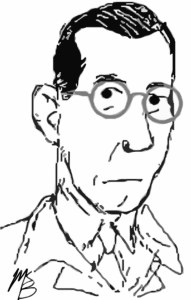
But his nickname among the men was ‘Claude’ because we thought he looked like Claude Dampier, the comedian. Mind you, Bellamy was no comedian. He was a tough, stern man, but fair, and a good Commanding Officer.
(Quoted in Thomas J. Bates, Search for Sidney, 34)
Born on 8 December 1910 in Westhampnett, Sussex, Robert Hugh Bellamy attended Sherborne School and the Royal Military College, Sandhurst, after which he was commissioned with Duke of Cornwall’s Light Infantry in 1930. He fought with the 2nd Battalion during the battle of France and was mentioned in dispatches. By September 1943, he was promoted to lieutenant-colonel in command of the 1st Battalion, Royal Norfolk Regiment.
On D-Day, as art of 3rd Infantry Division the unit landed on Sword Beach “under fairly mortar & shellfire.” For leadership over the next two months hard fighting in Normandy, Bellamy received the D.S.O.:
On 6 August 1944 Lt Col Bellamy’s battalion was heavily and determinedly attacked by enemy Tiger tanks and infantry covered by intense shelling and mortar supporting fire. The action lasted from 1400 hrs until dusk. The enemy tanks penetrated the position. The casualties amounted to the equivalent of two companies and included the whole of Bn HQ and its vehicles. Throughout this confused and grim action Lt Col Bellamy, by his cheerfulness, clear headedness and personal example was an inspiration to all ranks. It was the confidence which his appearance and calmness gave to his subordinates that helped them stand their ground after having been overrun with heavy losses.
In January 1945, Bellamy was promoted to brigadier of the 6th Airlanding Brigade in the 6th Airborne Division. He earned the D.S.O. Bar during Operation Varsity on 24 March 1945:
Gliders landing in daylight among the enemy guns inevitably suffered casualties. In fact, the Airlanding Brigade’s casualties, within 24 hours of landing, were between 20 and 25%. It speaks much for the inspiring leadership of the commander that in spite of these heavy losses, all the Brigades tasks were successfully and rapidly accomplished. Subsequently the Issel bridges were defended with great tenacity. Brigadier Bellamy was constantly in the forefront of the battle. He showed complete contempt for his own safety. His enthusiasm and determination infected his Brigade with the finest offensive spirit.
From late 1945 to 1946, Bellamy commanded 1st Parachute Brigade in Palestine and then the 2nd Parachute Brigade in West Germany until 1948. Following postings with the War Office and to overseas commands, he retired from the army in 1958.
He died in London on 27 November 1972.
 World War Graphic History