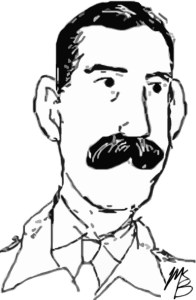
Lieutenant-Colonel D.L.A. Gibbs
1/6th Battalion, Queen’s Royal Regiment
2nd Battalion, Royal Warwickshire Regiment
I think this was one of the biggest shocks one sustained up to that period of the war. I had seen soldiers die and soldiers wounded; I had been at Dunkirk. I had amongst many, both military and civilian refugees, been the target of German dive-bombing, but, somehow, nothing had affected me so personally up till then as those one or two deaths in September 1942 at Deir-el-Munassib, perhaps, partly, because it was my ‘command,’ and the deaths within it were part of me.
(Quoted in Bryn Hammond, El Alamein, 2012, 145)
Born on 5 October 1905 in Abingdon, Berkshire, Denis Lucius Alban Gibbs was commissioned with the Queen’s Royal Regiment in 1926 after graduating from Royal Military College, Sandhurst. Following prewar overseas service in India and Sudan, he attended staff college and participated in the Dunkirk evacuation. In January 1942, he was promoted to lieutenant-colonel in command of 1/6th Battalion, Queen’s Royal Regiment.
He led the battalion into the North African theatre until he was captured at the Second Battle of El Alamein on 25 October 1942. He later wrote of his experience:
It is when you have nothing to do, or to think about, that a battle becomes very much more frightening. We obtained our objectives beyond the minefields on the enemy side of them and reorganised as best we could—not easy in an open and featureless desert. I suppose it was partly my own inexperience that ‘put me in the bag’ (as the saying goes) by the evening of 25th October following the attack. It has always been rather a mystery to me that I was awarded a DSO for it. I was probably rather further forward than I should have been, and J and a few others were isolated in the desert whilst the armoured vehicles, due to follow us up, were unable to break out of the minefields in our wake and thus we very shortly lost any support. We were extremely close up to the enemy forward defensive fire. I could hear the German orders to their guns quite clearly. If only our Armour had managed to follow us, the battle down on this southern flank would have been highly successful. After some eighteen hours of being shot up by German and Italian mortars and by German infantry guns (small pieces), I and a few others became prisoners of war.
(Quoted in Alexander McKee, El Alamein, 1991, 158)
Gibbs remained confined to a prisoner-of-war camp in Cremona, Italy for nearly a year. After the Allied invasion and Italian surrender in September, thousands of POWs managed to escape. Gibbs led a small group on a 625-mile trek through enemy-controlled country to the Allied lines, which he recorded in a diary privately published in 1944 as Apennine Journey. Gibbs was repatriated to the United Kingdom but would return to the field following the Normandy invasion.
Gibbs arrived as a replacement commanding officer after Lieutenant-Colonel Hoss Herdon of 2nd Battalion, Royal Warwickshire Regiment was killed just after D-Day. He earned the D.S.O. Bar for leadership in early August 1944:
Throughout this confused action, in which the battalion suffered heavy casualties, Lieut-Col. Gibbs had the situation well in hand. His calm, imperturbable behaviour was an inspiration to his junior leaders and soldiers. His clear orders, determination and complete disregard for his own safety under these very difficult circumstances had a most marked effect upon the course of the battle, and its successful outcome is a shining example of what the personality of a courageous leader can achieve.
After nine months in command, Gibbs was relieved and replacement by Lieutenant-Colonel R.C. Macdonald, an original Warwickshire Regiment officer serving as CO of the 1st Battalion, King’s Own Scottish Borderers.
Postwar Gibbs commanded the 1st Battalion, Queen’s Royal Regiment in the Far East and West Germany until 1948. He retired from the army two years later and died on 27 April 1984 in Gloucester, Gloucestershire.
 World War Graphic History