Lieutenant-Colonel “Swazi” Waller
1st Battalion, South Lancashire Regiment
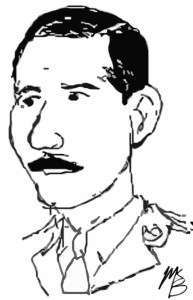
He was gifted with extreme personal bravery, which proved a great inspiration to all the battalion. To see him walking about, as he frequently did, amongst the leading troops and forward positions, completely indifferent to the heaviest enemy fire, was a great morale-boost to all. In addition, whatever the circumstances and however great the demands of the situation, he was always carefully shaved and immaculately turned out.
(Lt. Eddie Jones quoted in Tony Colvin, The Noise of Battle, 440)
Born on 28 August 1909 in British India, William Augustine Waller enlisted with the Worchester Regiment before being admitted to Royal Military College, Sandhurst. He was commissioned in the Duke of Wellington’s Regiment (West Riding) in 1930 and served with the 2nd Battalion in India and fought on the North West Frontier. His nickname came from an Indian Army tune “Swazi wallah.” After seven years overseas, Waller returned to England in 1939 and joined the 1st Battalion as a company commander. He was badly wounded during the evacuation from Dunkirk and earned the Military Cross for “utter disregard for danger.”
By the Normandy invasion, Waller had qualified as a staff officer and was posted to the 9th Infantry Brigade as brigade major. After Lieutenant-Colonel Richard Burbury of the 1st Battalion, South Lancashire Regiment was killed on D-Day, Waller joined as the new second-in-command. At the end of June 1944, a new commander took over but he was killed within a month. The next CO was relieved in mid-October, and Waller took over the 1st South Lancs.
Waller was noted for his bravery and coolness even under the most severe enemy fire. One officer recalled during a bombardment while escorting a group of POWs: “All the British officers and men instinctively ducked, except ‘Swazi’. The Germans didn’t duck either. As ‘Swazi’ said to me later, “That was a tricky situation. | didn’t want the Germans to think that we were scared of their shelling.”
Although “regarded as fire proof” by the battalion, Waller was not immune. In mid-April his jeep struck a mine and he was put out of action. Lieutenant-Colonel M.A.H. Butler, an original South Lancs officer in command of the 1st Battalion, Essex Regiment, returned to his old unit to succeed Waller.
After the war, Waller served in Malaya and Kenya, and was awarded with Officer of the Most Excellent Order of the British Empire. He retired from the army in 1964 and died in York in January 1999.
 World War Graphic History