Lieutenant-Colonel Richard Burbury
1st Battalion, South Lancashire Regiment
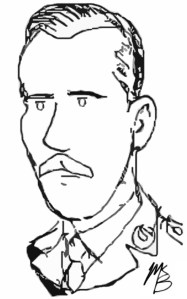
The colonel was such an obvious target—he had a flag in his hand in case there was going to be confusion and he could be rallied round, he waved his map as well. I think he was hit by a sniper. It happened several times actually. I served six commanding officers during the campaign. Two were killed, two were wounded …
(Arthur Rouse, IWM interview, 30 Jul 1994) journal, July 1944) https://www.iwm.org.uk/collections/item/object/80013951
Born on 1 April 1906 in Barnsley, South Yorkshire, Richard Percival Hawksley Burbury was educated at Ludgrove School and Eton College. He was commissioned with Duke of Cornwall’s Light Infantry in 1925 and served in India and Palestine before the war. He participated in the evacuation from Dunkirk in June 1940 and qualified for higher command. He was unit adjutant and briefly commanded the 2nd Battalion, DCLI from October to November 1942, when he relinquished the post due to ill-health. Nearly a year later, he became commanding officer of the 1st Battalion, South Lancashire Regiment.
In Bugles and a Tiger (1956), Colonel John Masters recounted his encounter with Burbury while he was adjutant with the Duke of Cornwalls. As a young and uncertain officer, Master had complained about what he “regarded as stupidity and unfairness in another officer”:
The adjutant was a fierce disciplinarian, but I liked and admired him. When I had finished speaking I thought for a moment that he was going to use his rank and position and blast me for daring to speak to him on such a subject. I curled up inside, ready to hate him and all of them. I was truly upset about what was happening, and I had asked him because I didn’t know what to do …
Burbury relaxed suddenly and ordered drinks. When the mess waiter had brought them, and we were again alone on the veranda, he said, ‘Do you think you’re being disloyal?’
I said, ‘No.’
Burbury said, ‘But you are.’ He smiled at me, and I, in my turn, relaxed. I had wanted for a long time to be able to ask questions about loyalty, duty, and obedience, and have them answered by someone who would not snap my head off. Eagerly I explained my position.
Burbury said, ‘Loyalty means backing up a man even when he’s in the wrong. Even if he’s stupid and inefficient. That’s why it’s so hard to be loyal.’
(Masters, Bugles and a Tiger, 28-29)
In the 1st South Lancashire Regiment, adjutant Captain Arthur Rouse recalled that Burbury brought the same disciplined and exactly style of command as the unit trained for the Normandy invasion. The battalion landed on Sword Beach on 6 June 1944 with the 3rd Division. As Burbury led the troops ashore, Rouse recounted, “his gaunt figure strode across the sand towards this gap in the sand hills. I followed him immediately and one or two people began to fall down behind as mortar fire and machine-gun fire came across and some fixed artillery firing along the line of the beach.”
As the battalion headquarters assembled, Rouse stated that Burbury “just turned to me with his map in his hand and said, ‘Where are we, Arthur?’ and then he was shot, immediately. And his jaw went into spasms and he dropped down.”
Second-in-command Major J.E.S. Stone immediately took over but he would be evacuated before the end of June.
 World War Graphic History