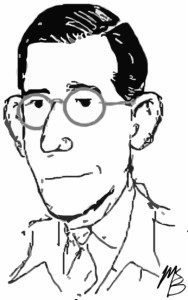
Lieutenant-Colonel Bill Renison
2nd Battalion, East Yorkshire Regiment
It was magnificent to see the majestic approach of wave after wave of big bombers, flying quite low in very tight formation at an almost pin-point target. As far as the eye could see they stretched out towards the sea and the sinking sun. As the raid progressed, a cloud of dust rose high into the air and blotted out almost everything, drifting slowly towards us and up the valley of the Orne. By the end of the raid the troops were standing on the end of their slit trenches clapping and cheering; the effect on morale was electric
(Renison journal, July 1944)
Born on 18 April 1909 Rock Ferry, Cheshire, James Douglas Willoughby Renison was an insurance broker and Royal Liverpool Club golfer. In the Territorial Army, he held a commission with the Liverpool Scottish (Queen’s Own Cameron Highlanders) since 1927. He was promoted to major in 1938, and served as second-in-command of the 1st and 2nd Battalions while stationed in Northern Ireland. Shortly after the Normandy landings, Renison joined a draft of reinforcement officers for the 2nd Battalion, East Yorkshire Regiment.
Renison stepped in as second-in-command under the new CO, Lieutenant-Colonel N.J. Dickson. The 2nd East Yorks had landed on D-Day with the 3rd Division and had suffered several casualties to its senior ranks. He recorded of a conversation with Dickson, “We both agreed that being 2 i/c is a dreadful job, waiting for dead man’s shoes.” On 16 October 1944, Renison replaced Dickson who had to be pulled out of the line due to battle exhaustion. He remained in command throughout the North West Europe campaign and earned the D.S.O.:
His conduct under fire was an inspiration and an example to all around him. There is no doubt that the skillful leadership and resourcefulness of this Commanding Officer were to a great extent responsible for the capture and holding of a bridge vital for the successful continuation of the operation.
On 17 April 1945, the legendary second-in-command Major Charles Kenneth “Banger” King died of wounds after his jeep hit a mine. King had fought with the battalion since D-Day and famously recited the St. Crispin’s Day speech from Shakespeare’s Henry V to motivate the troops before landing at Sword Beach. “No words can really express what this means to the morale of the bn,” Renison wrote, “and as the days and hours passed by, I realised more and more how much I had depended on him in so many things.” When he learned of the unconditional surrender of German forces on 4 May 1945, the colonel recorded in his journal: “Thus did I hear the news we had been all waiting for. It seemed an anti-climax.”
Renison commanded the 2nd East Yorks in the occupation of Germany until August 1945 when he took charge of a POW camp. He commanded the 1st (Motor) Liverpool Scottish Regiment from February 1947 until retirement from the army in June 1950. In civilian life, he was director for an insurance brokage firm and secretary for the Royal Liverpool Golf Club. He also reviewed books, usually on military themes and war veteran memoirs for the Liverpool Daily Post.
He died in Birkenhead, Cheshire on 13 July 1992.
 World War Graphic History