Lieutenant-Colonel R.W. Craddock
2nd Battalion, South Wales Borderers
1st Battalion, Suffolk Regiment (The Buffs)
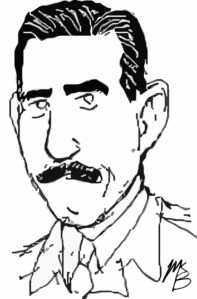
The speech he made on the 9th October marked him out as a great man, knowing the men he commanded. True to his word he was indefatigable in visiting the forward positions till, later in the battle, falling a victim to a German mine, he was very badly wounded . Even so, with a shattered leg, he had crawled out of the mine field before being picked up, and he could still joke about the limb he had lost. His name was for long a legend in the First Battalion.
(Walter Norris Nicholson, The Suffolk Regiment, 1928 to 1946, 128)
Born on 3 August 1910, Calcutta, British India, Richard Walter Craddock was Sandhurst educated and a commissioned officer in the Royal East Kent Regiment (Buffs) since 1930. He served during the Battle of France as captain and adjutant in the 2nd Battalion, Buffs, which was recognized with an award of the Member of the Most Excellent Order of the British Empire. In 1943, he was posted to Prime Minister Winston Churchill’s delegation for the conferences in Washington, D.C., Quebec City and Cairo.
In March 1944, he took command of 2nd Battalion, South Wales Borderers just months before Operation Overlord. For security purposes, he ordered troops to stay with a barbed wire perimeter. A sergeant recalled, “Some men did not get out and there was hell to pay and the CO addressed the battalion and he was saying how dangerous this was and that those who did not get out should have been hanged! This was Lt. Col. Craddock and he was a bit of a fire-eater!” (Quoted in Andrew Holborn, 56th Infantry Brigade and D-Day, 53).
The battalion landed at Gold Beach on 6 June 1944. Craddock waded ashore with a swordstick and pistol but was shot in the shoulder on D-Day+2. Although only two days in action, his impressive leadership in the assault was rewarded with the D.S.O.:
During it all, Lt-Col. Craddock was always right forward directing his battalion and encouraging everyone. Early in the offensive he was wounded but refused to leave until long afterwards he was ordered back.
He set a magnificent example of leadership and by his fearlessness and personal courage so inspired his officers and men that in the end a most resolute and determined enemy was overcome.
He was reluctantly evacuated and command of the 2nd SWB passed to Major F.F.S. Barlow. After recovery, Craddock returned to duty with his original regiment. He was posted to take command of 1st Battalion, Suffolk Regiment at the end of August 1944. Before the offensive at the Maas River in October, Craddock delivered “an inspiring address” to the whole battalion, warning of the severe fighting ahead of them. In Regimental Stretcher Bearers in Action! (1951), Gordon Scriven wrote of the colonel’s speech:
He did his best to encourage his men and was very plain of speech. In his remarks he told them that there were bound to be casualties, although as always, some men would survive the worst bombardment. He concluded his address by wishing them good success–telling them that all men felt afraid sometimes, but courage really was the ability to conquer one’s fears.
On 16 October, while advancing toward a forward company, he stepped on a mine that blew off his foot. He managed to crawl on his back before being picked up by stretcher bears who inadvertently set off another mine. Under heavy fire, a corporal managed to carry the wounded colonel to safety.
In the postwar army, Craddock held several assignments from assistant to the Chief of the Imperial General Staff to the War Office to overseas postings to Germany and Hong Kong. He retired in 1966 at the rank of major-general and then served as colonel of the Queen’s Regiment until 1973.
He died in Andover, Hampshire on 14 February 1977.
 World War Graphic History