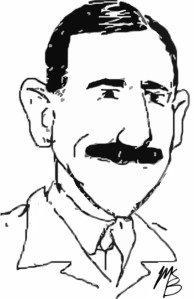
Lieutenant-Colonel Kit Gough
1st Battalion, Suffolk Regiment (The Buffs)
The role of 1st Suffolk on D day was: 1st to capture a Battery of guns covering beach 2nd To clear the village of Coalville 3rd To capture strong point “Hillman.”
First two were easy, but “Hillman” proved difficult nut to crack, & was finally taken about 7 PM “D” day. The slowness has been the subject of severe criticism in the Book (forgotten name!) concerning the whole campaign in N.W. Europe. When I visited “Hillman” last year, (most of the concrete works remain) I pondered over the problem again, and realised what a tough egg it was.
(Gough questionnaire, Cornelius Ryan WWII papers, box 021, folder 04, 1958)
Born on 30 August 1907 in Pocklington, Yorkshire, James Gordon Milestone Boulter Gough was commissioned into the Lincolnshire Regiment in 1928. During the 1930s, he served overseas with the 1st Battalion in Gibraltar, Shanghai, Hong Kong, and India. He was a company commander with the 2nd Battalion during the Battle of France in 1940. Afterwards he became second-in-command, then at the end 1942 was instructor at the school of infantry. In October 1943, he was posted to the 1st Battalion, Suffolk Regiment as second-in-command.
As part of the D-Day landings, the battalion landed on Sword Beach under the command of Lieutenant-Colonel R.E. Goodwin. “Very rough,” Gough recalled of the voyage across the Channel, “most men seasick. Being a bad sailor myself found great difficulty in issuing secret documents.” In response to Corenlius Ryan’s research questionnaire for The Longest Day, Gough described his first impressions on landing:
- The wreckage & confusion on the beach.
- The smooth working of the Regimental task, which was carried out according to plan, with few casualties.
- The calm & quietness of the first nigh ashore.
Gough took command after Goodwin was wounded on 9 June. He led 1st Suffolks through the heavy fighting around Caen and Falaise until he was wounded himself on 12 August. A shell struck battalion headquarters injuring several senior officers including Gough and the second-in-command. Major F.F.E. Allen took over. The regimental history expressed “great regret” at the loss of Gough:
he had most loyally and capably served the Suffolk Regiment. Throughout the Campaign, the First Battalion was singularly fortunate in the senior officers of other Regiment who served with the Battalion, but none was better known or more respected than Lt-Col. Gough.
After recovery, Gough was appointed to command 2nd/6th Battalion, the East Surrey Regiment, in a training division at Shorncliffe. He retired from the army in 1947.
Gough died on 10 June 1988 in Bournemouth, Hampshire.
 World War Graphic History