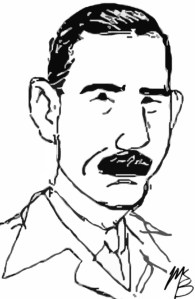
Lieutenant-Colonel Dick Goodwin
1st Battalion, Suffolk Regiment (The Buffs)
I am just writing this letter to you before setting out on the great adventure … There is very little else to say as one can’t say much. I expect you will hear all about everything before you get this. Don’t worry too much because it won’t do anyone any good! … There will be much to tell you when I see you next.
(Goodwin to wife, 5 Jun 1944) https://ve-vjday80.gov.uk/letter/lt-col-dick-goodwin-to-anthea-goodwin/
Born on 17 August 1908 in London, Richard Elton Goodwin was commissioned with the Suffolk Regiment in 1928 after education at Cheltenham and Royal Military College, Sandhurst. While serving in India, he became aide-de-camp to the Governor of Madras in 1935. After the outbreak of war, Goodwin was second-in-command of 9th Battalion, Royal Warwickshire Regiment before returning to the Suffolks as commanding officer of the 1st Battalion in June 1943.
One year later, on 6 June 1944, the battalion landed on Sword Beach as part of the 3rd Infantry Division. After three days in action, Goodwin was severely wounded when anti-tank fire struck his armoured carrier. Writing from a hospital one month later, he updated his wife on his condition: “Just a very quickie to tell you the skin graft as far as can be told was a huge success and according to the [nursing] sister, Mr. Campbell did it beautifully—the wound is apparently absolutely sterile now. Anyway I can’t feel anything from my arm now so he must have done it well; my left leg is a bit sore where they took the skin from but not too bad at all.” (Goodwin to wife, 7 Jul 1944) https://ve-vjday80.gov.uk/letter/lt-col-dick-goodwin-to-anthea-goodwin/
Although his service as a combat leader at Normandy had been cut short, he was recognized with the D.S.O.: “It was due to this officer’s careful planning and clear appreciation of the situation that the operations were carried out with complete success. Constantly under fire throughout the battle his calm bearing and fine example of courage and determination inspired the officers and men of his battalion.” Command passed to Major Kit Gough. After several further command changes over the coming months, a recovered Goodwin rejoined the 1st Suffolks as CO on 7 November 1944. He remained in command until the end of the war in Europe.
Postwar he attended staff college, was infantry school commandant and commanded a brigade in West Germany. In 1960s, he became general officer commanding (GOC) East Africa Command and three years later was GOC 1st (British) Corps within the British Army of the Rhine. Goodwin retired from the army as a lieutenant-general in 1969.
He died on 28 October 1986 in Bury St Edmunds, Suffolk.
 World War Graphic History