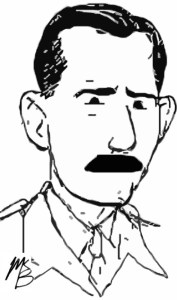
Lieutenant-Colonel P.J. Luard
13th (Lancashire) Parachute Battalion
The battalion had been on the move and in action for forty-eight hours, almost without let-up, and was very tired. So, we stayed where we were. I had a company commanders meeting and in the middle of it, I was so tired that I went to sleep as I was actually talking. They left me sleeping, and left word that I was not to be disturbed. I woke up two hours later and the rest of the meeting was resumed, with my apologies.
(Quoted from Airborne Assault Museum) https://paradata.org.uk/content/4642689-lieutenant-colonel-peter-luard
Born on 6 June 1911 Warblington, Hampshire, Peter John Luard was the son of a British Navy admiral and a commissioned officer in the Oxfordshire and Buckinghamshire light infantry since 1931. He served in Burma during the early 1930s and qualified as a staff officer in 1941. Following appointments with the 6th Battalion, Ox and Bucks and to 31st Infantry Brigade, Luard volunteered to be a paratrooper in early 1942.
He served as second-in-command of the 4th Parachute Battalion until September 1943 when he was promoted to take over the 13th Battalion, succeeding Lieutenant-Colonel G.A.B. Russell. As part of 5th Parachute Brigade, 6th Airborne Division, the battalion dropped behind enemy lines in Normandy early in the morning of 6 June 1944, which happened to be his birthday.
He led the 13th throughout the battle of Normandy and a subsequent D.S.O. citation for operations in late August praised his leadership: “This fine performance followed close on three months of outstanding work: Lieutenant-Colonel Luard had dropped with his Battalion on the night of June 5th/6th and had speedily secured the objectives allotted to him. His leadership and example had played a big part in keeping up the morale of his Battalion during the difficult period of defensive fighting at Le Mesnil. During the advance to the River Seine and particularly at Putot-en-Auge on the 19th August his energy, determination and courage was a source of constant inspiration to all ranks.”
In September 1944, the 6th Division was withdrawn to regroup in the United Kingdom. It returned to the field in January 1945 during the German offensive in the Ardennes. He remained in command of the 13th until Germany’s surrender after which the battalion was sent to the Far East for the anticipated final campaign against Japan. Luard relinquished command in February 1946 and retired from the army in 1948.
Luard became a sheep farmer in Wiltshire and for a time was an elected county councillor. Luard died 1 January 1978.
 World War Graphic History