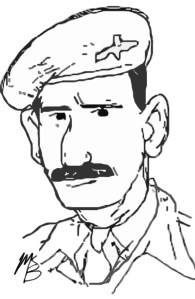
Lieutenant-Colonel Johnny Johnson
12th (Yorkshire) Parachute Battalion
Everything opened up. There was airbursts and there was machine gun fire coming right across, tracer bullets coming at us, mortars being dropped and shells … There were a few of us around there. There was the C.O., the second-in-command, the adjutant, I think there must have been about half a dozen. And there was such a bang against this wall that I wondered what it was. I didn’t know evidently it was a shell that had dropped amongst us … it killed the C.O.
(Ronald Dixon, IWM interview, 3 Sep 1999)
Born on 28 July 1911 in Maidenhead, Berkshire, Alexander Percival Johnson was commissioned into the Suffolk Regiment in 1931. He had previously been educated in Switzerland before graduating from the Royal Military College, Sandhurst. Just as he completed staff college in 1941, the British Army had started to form the new airborne forces. As an adventuring sportsman with an interest in skinning and mountain climbing, Johnson volunteered as a paratrooper.
By 1943, he was second-in-command of the 12th (Yorkshire) Parachute Battalion, which had. When Lieutenant-Colonel Reginald Goulbourne Parker was promoted to deputy commander of the 6th Airlanding Brigade in February 1944, Johnson assumed command of the 12th Battalion. Four months later, he led the unit in the drop over France as part of 5th Parachute Brigade in the 6th Airborne Division. Landing in the early morning before D-Day, he gathered his scattered troops and secured objectives as the battle of Normandy began.
On 12 June, Johnson prepared an attack on Bréville with 300 paratroops in coordination with a company from the 12th Devonshires. During the assault, supporting naval guns or artillery fire fell short of their targets and one shell hit a gathering of senior officers. Brigadiers Lord Lovat and Hugh Kindersley, and Colonel R.G. Parker were wounded but Johnson was killed by the suspected friendly fire. After less than week in action, he received a posthumous D.S.O.:
His courage leadership and skill were an inspiration to the remainder of his Battalion and his task was successfully accomplished.
On the 7th June, Lieutenant-Colonel Johnson’s Battalion held its ground against more attacks by infantry with self-propelled guns in support. The assaults were pressed at point blank range and in some places penetrated into his position. Lieutenant-Colonel Johnson’s brilliant handling of his Battalion, his coolness under fire was directly responsible for the successful defence of the position as a whole and to the final reoccupation of our original line.
Major N.C. Stockwell took over until Lieutenant-Colonel W.A.B. Harris arrived the next day. Harris would be wounded by a sniper on 7 July and afterwards Stockwell assumed command once again until after the battalion was withdrawn from Normandy.
 World War Graphic History