Lieutenant-Colonel Hank Carson
1st Battalion, Royal Ulster Rifles
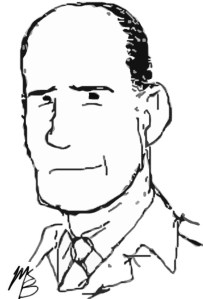
His tactical ability has always been sound, his planning painstaking and thorough. His battalion has always maintained a high morale and in the most difficult conditions their cheerfulness has been noticeable and outstanding. This is to a very large extent due to the personality and example set by their commanding officer.
(O.B.E. citation, 29 Apr 1952)
Born on 18 July 1909 in Mussoorie, British India, Robert John Heyworth Carson was educated at Charterhouse and RMC Sandhurst. After taking a commission the Royal Ulster Rifles in 1929, he served around the world including in Northern Ireland, Palestine, Egypt and Hong Kong. Carson briefly commanded the 70th (Young Soldiers) Battalion, Royal Ulster Rifles, a unit formed in 1940 for underaged soldiers too young for conscription. In February 1943, he succeeded Lieutenant-Colonel R.J.R. Campbell in command of the 1st Battalion, RUR.
With the formation of the British airborne forces in 1941, the 1st RUR had converted to glider infantry in the 1st Airlanding Brigade. In April, the battalion transferred to the 6th Airlanding Brigade as apart of 6th Airborne Division. The 1st RUR deployed to Normandy on 6 June 1944 in Operation Mallard, and served throughout the campaign until the 6th Division was withdrawn in September.
The battalion deployed to Belgium during the German Ardennes offensive in January 1945, and three months later participated in its final airborne action in Operation Varsity at the Rhine in March. Carson’s glider crash landed leaving him badly injured. “If Arnhem had been one of my best landings, then this was one of my worst,” glider pilot staff sergeant H.A. Andrews recalled. “Until we got to 500 feet I couldn’t see the ground and, when we did, there was no place to land … I got through the trees but the undercarriage was half off. The next thing I knew was that the Horsa II was disintegrating around me, and the trail detached itself to fly over the nose and land facing me.” Carson needed to be evacuated to a regimental aid post and command of the 1st RUR passed to Major G.P. Rickcord, who led the battalion until the end of the war.
By the Korean War in 1950, Carson had since resumed command of 1st RUR, and declared on embarking for the peninsula in October, “I would like to say that we are very proud to be part of a force that is going to Korea to help to finish off this most important and worth-while task.” The battalion served with the 29th Independent Infantry Brigade Group although Carson missed the key battle of the Imjin River in April 1951 while on sick leave in Japan. For his long service as battalion commander, Carson was awarded the OBE in 1952.
He died in Stalbridge Weston, Dorset on 2 May 1983.
 World War Graphic History