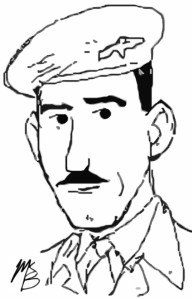
Lieutenant-Colonel Dick Stevens
12th Battalion, Devonshire Regiment
And I am doubly certain that we can never achieve either leadership or friendship in India if we depend upon the crumbling façade of caste which has protected Englishmen in India in the past. We must either make India a willing associate or else get out … we are prepared to relinquish our status as superior beings and are willing to become partners and associates in the business of living in India.
(Col. G.R. Stevens to East India Association, 13 Dec 1944)
Born on 4 October 1908 in Boyle, County Roscommon, George Richard Stevens was educated at Cheltenham and Royal Military College, Sandhurst. He took a commission with Royal Fusiliers (City of London Regiment) in 1928, and served tours of duty with the 1st Battalion in India during the 1930s. He commanded a company in the Western Desert campaign and then in 1942 went to the Staff College, Camberley as an instructor. Following a GSO 1 appointment to the airborne forces, in 1943, he became second-in-command of 12th Battalion, Devonshire Regiment.
In June 1943, the 12th Devons had converted to glider infantry and joined 6th Airlanding Brigade in 6th Airborne Division. In November, Stevens succeeded Lieutenant-Colonel R.F.B. Hill, a First World War veteran, in command of the battalion. Over six months, the brigade deployed to Normandy on 6 June 1944 in Operation Mallard. At the beginning of August, Stevens was posted to the general staff at 21st Army Group headquarters and succeeded by Major Paul Gleadell.
Stevens became senior British liaison officer to 1st Polish Parachute Brigade, and coordinated with Brigadier Stanisław Sosabowski during Operation Market Garden in September 1944. In spring 1945, Stevens transferred to the Far East to take command of 10th Battalion, Gloucestershire Regiment and ended the war as acting commander of 72nd Infantry Brigade in Burma.
During the Korean War, Stevens returned the 1st Battalion, Royal Fusiliers, which he commanded as part of the 28th Commonwealth Infantry Brigade from 1952 to 1954.
After a long army career, he retied to the Isle of Wight, where he died on 28 November 2000.
 World War Graphic History