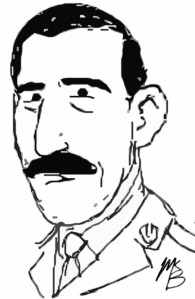
Lieutenant-Colonel R.W.M. De Winton
5th/7th Battalion, Gordon Highlanders
1st Battalion, Tyneside Scottish
2nd Battalion, Gordon Highlanders
I did not mean to hit the man or the uniform. I wanted to hit only the major representatives of the Big Four at Pola. Unfortunately he was a man and a soldier. If I had had the occasion, I would have hit the Big Four—as a symbol of the injustice to my country.
(Maria Pasquinelli in Associated Press, 19 Mar 1947)
Born on 16 September 1908 in Edinburgh, Scotland, Robert William Michael De Winton was a graduate of Royal Military College, Sandhurst and a commissioned officer in the Gordon Highlanders since 1932. He temporarily took over 5/7th Battalion in Sicily in August 1943 and then commanded 1st Battalion, Tyneside Scottish from January 1944 until it deployed to France after D-Day.
For his leadership on 1 July, he received the D.S.O.; with the citation reading in part: “He dealt with each situation with a calm determination which is beyond all praise. He frequently organised local counter-attacks and in doing so showed complete disregard for his personal safety. That the position was successfully held is due in large measure to the brilliant and gallant leadership of this officer.”
After being wounded De Winton needed to be evacuated and command passed to Major D.N. Nicol. By September 1944, he had recovered to take over 2nd Battalion, Gordon Highlanders in the 15th Scottish Division. He received a D.S.O. Bar for leading the breakout from the Elbe River on 29 April:
Lt Col de Winton with calmness and indifference to the shell fire remained at the waters edge and to encourage his men, and to ensure that the crossing was not delayed, did not take cover but walked about under fire, organising the embarkation of his troops …
Throughout the operation this officer behaved in a most gallant manner. By his energy and aggressiveness he always influenced the run of the battle. His personal bravery under fire was a fine example to his soldiers who were inspired to fight with great dash and determination.
Over a month after VE Day, de Winton became acting commander of 227th Brigade and then in August was promoted to brigadier of 13th Infantry Brigade. On 10 February 1947, he was stationed in Pola, Venezia Giula to oversee the handover of the city from Italy to Yugoslavia according to the Trieste agreement. While inspecting a small guard of troops, a 34-year-old Italian school teacher named Maria Pasquinelli approached from behind and fatally shot him three times. She was immediately apprehended and charged with murder.
“I rise in rebellion,” she wrote in a confession note, “with the firm intent of killing the man who is unfortunate enough to represent the Four Great Powers, that, at the conference in Paris, in violation of justice, against humanity and against political wisdom, have decided to tear out once more again from the maternal womb lands of most sacred to Italy.” During the war, she had disguised herself to fight in North Africa before being discovered, and remained a committed fascist even after the fall of Mussolini. At her trial she proclaimed, “the greatness of Italy could be best achieved by fascism.” The Allied military tribunal sentenced her to death which was soon commuted to life imprisonment, although she had claimed to have sought martyrdom.
Under political pressure, in 1964, the Italian government released Pasquinelli and granted her a pardon. She died in March 2013.
 World War Graphic History