Lieutenant-Colonel Roy Exham
6th Battalion, Duke of Wellington’s Regiment
6th Battalion, Green Howards
I will not attempt to describe another action which we fought as all I can remember is a bloody time when three soldiers were killed at my side. Again we captured our objective. It was an unpleasant time and my sympathies went to the forward companies, which were dug in close to the Germans and could not see anything, were unable to move and were shelled most of the time. There was a wondaful feeling of relief when at last we were on the move.
(Exham quoted in Mike Morgan, D-Day Hero)
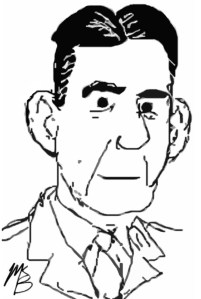
Born on 25 January 1907 in Readlynch, Wiltshire, Robert Kenah Exham took as commission in the Duke of Wellington’s Regiment (West Riding) in 1926 after graduating from Royal Military College, Sandhurst. He served on the North West Frontier in India before the Second World War. As a staff officer with 3rd Infantry Brigade in June 1940, he earned the Military Cross for invaluable assistance during the evacuation from Dunkirk.
Brigadier T.N.F. Wilson wrote in his award recommendation:
Administrative arrangements for the Bde invariably worked without a hitch. This was mainly due not only to Capt. Exham’s ability, untiring energy and grasp of the situation but also to his frequent visits to forward units in order to obtain first hand knowledge of their requirements and difficulties. These visits were paid with complete disregard for all personal danger. I cannot speak too highly of Capt Exham’s work at all times.
Following staff appointments, in February 1944, Exham succeeded Lieutenant-Colonel C.F. Tissington as commanding officer of the 6th Battalion, Duke of Wellington’s Regiment. His older brother Kenneth Godfrey Exham commanded the 7th DW from August to October 1943, then the 9th Battalion, Worcestershire Regiment from October 1943 to May 1944 and then 6th Battalion Royal Welch Fusiliers in France.
The 6th DWR deployed to Normandy with the 49th Division a week after D-Day. June 1944 would prove fatal for the unit. On the 17th, it suffered terrible losses in its first engagement with virtually all officers either killed or wounded. Lieutenant-Colonel Trevor Hart Dyke of the Hallamshire Battalion recorded the aftermath:
Large numbers came through my battalion rather shaken from this terrible ordeal in their first action. I was very sorry for Roy Exham and his 2 i/c, both very good chaps and was glad to be able to offer them a nip of whisky, a cigarette and a snake before they reported back to their Brigadier.
While the 6th DWR regrouped, Exham was replaced days later to be posted to another battalion. The second-in-command expressed: “His departure was deeply regretted by the Battalion. By now, indeed, there were almost more ‘non-Dukes’ than ‘Dukes’ in the unit. Quite a number of the reinforcements, both officers and men, were from another Battalion of the Regiment.”
Shortly thereafter, Lieutenant-Colonel A.J.D. Turner assumed command from an instructional position in England. An even greater disaster followed a few days later when the battalion broke ranks and seemed to panic under fire. Turner recommended the battalion be withdrawn to recover or be disbanded. It was broken up in July 1944 with drafts used to reinforce the 7th Battalion. General Montgomery wrote to Exham to express regret over the situation:
There are many TA battalions , and even regular units , that have had the misfortune never to cross the channel at all . I am I am therefore afraid that this is one of the cases where Regimental considerations must give place to the common good . I feel sure that you and your officers and men will accept this decision in a proper spirit
Meanwhile, on 28 June, Exham had taken command of the 6th Green Howards, succeeding a wounded Lieutenant-Colonel R.H.W.C. Hastings. On arrival, he recalled, “They gave me a very warm welcome. As I expected, we were in the worst of the bocage country and could see practically nothing. I was warned that our position was constantly being shelled and mortared.” He led the battalion through the end of the battle of Normandy but was wounded on reconnaissance in September. “I was immensely proud that I had the honour to command 6th Green Howards,” he later reflected, “and I only wish that I had been able to stay with them longer.”
Exham ended the war as a general staff officer and became an Officer of the Order of the British Empire in 1946. His long postwar army career including a command in the Middle East during the Suez crisis and deputy chief of staff for Northern Europe HQ. He was director of Land/Air Warfare with the War Office from 1957 until retirement as a major-general in 1960.
Exham died on 21 January 1985.
 World War Graphic History