Lieutenant-Colonel F.W. Sandars
11th & 10th Battalions, Durham Light Infantry
1st Battalion, Leicestershire Regiment
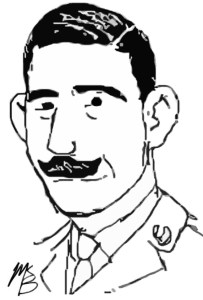
Throughout Lt. Col. Sandars displayed outstanding devotion to duty and disregard for his personal safety. His HQ and the whole Bn area was frequently under heavy arty fire. This officer moved about the Bn area to carry out a recce, make a plan, and issue orders.
(D.S.O. citation, 21 Dec 1944)
Born on 18 April 1903 Egremont, Cheshire, England, Francis Wyld Sandars attended Wellington College and Royal Military College, Sandhurst before taking a commission with the Durham Light Infantry in 1923. He served with the 2nd Battalion in India, Shanghai, and Waziristan. Back in the United Kingdom during the 1930s, he completed Staff College at Camberley and held general staff appointments in the UK after the outbreak of the Second World War. In January 1942, he returned to the Durham Light Infantry on appointment to command the 11th Battalion.
In July 1942, he transferred to Northern Command to be GSO 1, and a year later assumed command of 10th Battalion, DLI in the 70th Infantry Brigade. Another year on, Sandars and the battalion landed in Normandy in June 1944 shortly after D-Day. He earned the D.S.O. for a difficult fight at Mesnil-Mauger:
The leading Coy succeeded in crossing the river but were at once pinned by arty and MG fire on the far bank. Lt. Col. Sandars then organised an attack with two coys supported by an arty programme. This attack was successful but in the early hours of 20 Aug the enemy counter-attacked in some strength and succeeded in regaining the feature … By the time his Bn had gained the feature all his Coy Comds were casualties resulting in some disorganisation. This officer displayed outstanding coolness and determination in dealing with the situation … When his bn was driven back he again displayed outstanding coolness in dealing with a difficult situation.
At the end of August, the 70th Brigade was disbanded to provide needed reinforcement to other frontline units. In September, Sandars took command of 1st Battalion, Leicestershire Regiment, which had suffered heavy casualties since replacing the 6th Duke of Wellingtons in July. The commanding officer had been wounded at Caen and the second-in-command was later killed in action. For his leadership in Belgium during a counterattack in late October, Sandars received a D.S.O. Bar:
Lieut-Col. Sandars went forward to rally the remnants of the overrun Company and to organise the move forward of a Reserve Company. To do this he had to expose himself to enemy fire, and on the arrival of some tanks which had come to his support, he again exposed himself while directing the tanks to the best battle positions … During the whole action which lasted until nightfall Lieut-Col Sandars remained calm and in command of the situation and his example and coolness were an inspiration to his Battalion.
By May 1945, Sandars commanded 304th Infantry Brigade in Norway following the surrender of the occupying German forces, and in June took over the Tromsø Zone. The Norwegian government awarded him King Haakon VII Freedom Cross: “His command extended over hundreds of miles and the troops at his disposal were limited. The excellence of his arrangements and his tactful liaison with the Norwegian authorities were such that the tasks allotted were most efficiently carried out. Many thousands of Germans were marshalled, disarmed and finally evacuated. A large number of Russian ex PW many of whom were sick were also evacuated.”
After an appointment with the British Army of the Rhine headquarters, he went to the Imperial Defence College in 1950, and then returned to Germany in 1954 to command the Independent Brigade in West Berlin. Sandars retired from the army in 1955 and died in Spain on 16 October 1986.
 World War Graphic History