Lieutenant-Colonel Felix Wilsey
7th Battalion, Duke of Wellington’s Regiment
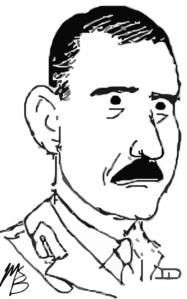
The commanding officer with whom I most frequently discussed matters affecting morale was my friend. Felix Wilsey. He made a point of chatting with his soldiers during the tense times before battle, admitting that it was natural to feel jittery admitting that it was natural to feel jittery and jumpy at such times, as he himself well knew. Did they feel at all like that? Well, they could take it from him that it would all be forgotten once the real action began, when no one would have time to be jumpy, and so on.
(Frank M. Richardson, Fighting Spirit: A Study of Psychological Factors in War, 118)
Born on 29 November 1904 in Camberley, Surrey, John Harold Owen Wilsey graduated from Haileybury and Imperial Service College and later attended the Royal Military College, Sandhurst. He took a commission with the Dorset Regiment in 1924 and transferred to the Worcestershire Regiment in 1936. Following general staff duties at the start of the war, he took command of the 9th Battalion, Worcestershire Regiment in January 1943.
In November 1943, Wilsey became command officer of the 7th Battalion, Duke of Wellington Regiment in the 49th Division. After initial training to be part of the beach assault force, the battalion arrived in Normandy a week after D-Day. For his leadership throughout the subsequent hard battles from the breakdown to the Low Countries, Wilsey received the Distinguished Service Order:
During all this varied fighting, the bn has always been successful. That these successes were achieved, and with comparatively light losses, was entirely due to Lt-Col Wilsey’s leadership and efficiency. There is no doubt that his example has been an inspiration to his bn and he has never spared himself so that he has always got the best out of his bn.
Following reorganization of the British forces during and following the Normandy campaign, the 6th Battalion, DWR was disbanded and reinforced the 7th DWR. The 70th Infantry Brigade was also broken up in August, and one of the Cos, Lieutenant-Colonel Denis Hamilton, formerly of 11th Durham Light Infantry, became the new second-in-command under Wilsey. He wrote in his memoir of his arrival to the 7th DWR:
I also dropped down to Major. It could have been awkward, considering that I had been fighting as a lieutenant-colonel and battalion CO since D-day, but my new superior was being groomed as an understudy brigadier and it was assumed that for much of the time — as in England — I would be the effective commanding officer.
By January 1945, Wilsey was promoted to brigadier of 158th Brigade, 53rd (Welsh) Infantry Division, and Hamilton officially took over as CO of 7th DWR. Proving himself an able brigade commander, Wilsey added a Bar to his D.S.O. Not he had been appointed in the middle of the battle of the Ardennes, citation read in part: “It would difficult to imagine a more trying moment to take over but Brig. Wilsey remained quite unperturbed. He immediately took control, the enemy counter-attack was beaten off and his Brigade’s attach the next morning was a complete success.”
His successor, Lieutenant-Colonel Hamilton, wrote: “He was off within 12 hours and 12 hours later was ordering his Brigade into action in the Ardennes. Few battalions had kept their C.Os. so long as ours and none have had a better leader than Felix Wilsey.” He commanded the brigade for virtually the entire Northwest campaign until the end of he war in Europe.
In the postwar army, Wilsey commanded a brigade, acted as director of infantry then director of staff duties, and retired as major-general of 2nd Division in 1956.
He died on 20 July 1961 in St. Saviour, Jersey.
 World War Graphic History