Lieutenant-Colonel Denis Hamilton
11th Battalion, Durham Light Infantry
7th Battalion, Duke of Wellington’s Regiment
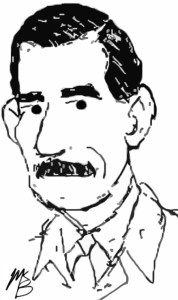
I can’t hide from myself the fact that on many occasions I was either uncertain of the outcome or plain scared. But as commanding officer you had to show yourself, and show yourself totally in command of yourself and the situation, for the troops instinctively get to feel whether the commanding officer is going to keep control or not. Quite a number of COs were removed, either because they lost their nerve through not being able to get enough sleep or clearly lost the confidence of the troops.
(Hamilton, Editor-in-Chief: The Fleet Street Memoirs, 39)
Born in South Shields, England on 6 December 1918, Charles Denis Hamilton was a former King’s Scout and newspaperman. Anticipating a future war and possible conscription, he joined the Territorial Army and took a commission with the Durham Light Infantry in 1937. He served during the evacuation from Dunkirk in June 1940, and then began training for defence of the anticipated German invasion. “We soon had a powerful battalion,” he wrote of the 11th DLI, “… I grew a moustache in the faint hope that I too might look older. I was never to shave it off.”
As the threat of invasion passed, the 11th Battalion set off for garrison duty in Iceland in late 1940. Hamilton was promoted to major, and after a year the battalion returned to the United Kingdom, where it began training for the eventual invasion of the continent. Hamilton became second-in-command under Lieutenant-Colonel Nigel Poett and took temporary command in September 1943 until the arrival of Lieutenant-Colonel J.M. Hanmer in November 1943. Hamilton reflected of this period his memoir:
Thinking back on the years preceding our invasion, one thing stands out in my mind. Never for one moment did I think that the British Army could lose the war. Even after Dunkirk, standing-to every night along the Slapton Sands, night after night, week after week, for four months, I never had a single doubt that we would prevail. Similarly, I never had any doubt that I personally would survive the war. Not until later, after the bitter fighting in Normandy and Holland, did I recognise how extraordinarily fortunate I had been.
As part of the 70th Brigade, the 11th Battalion landed in Normandy on 7 June 1944. During Hanmer absence, Hamilton served as acting commanding officer. “I wasn’t alarmed at having to take over in the field,” he wrote. “I felt I could stamp my own authority on the battalion and could give clear orders even when receiving, myself, rather tentative ones from above. I felt that I could think things through, and in moments of stress I could still provide sound decisions.”
Under intense enemy fire and bombardment, he pointed out: “In a sense, the ideal officer or soldier is the man you might call moderately brave, neither cowardly nor full of bravado. For the ordinary bread-and-butter work of the battlefield you need determined soldiers who, while inwardly frightened, realise there’s a job to be done.” The heavy casualties in Normandy combined with reinforcement shortages, required the 70th Brigade to be disbanded and broken up. In his final order to the battalion, Hamilton announced:
General Montgomery’s news that the end of the War is in sight has softened the blow which suddenly hit the 11th this week. We are suffering, for the sake of the War, the fate so many Battalions have had in the past year. Good reinforcements are wanted quickly and we, who had been raised for this emergency, were the ones who would provide them.
In the midst of our sadness I would say this. For five years we trained a team to beat the Hun. Our success at Rauray and since will be a Regimental Battle Honour – our overwhelming defeat of the German counter-attack has had a vital effect on the campaign. We have been allowed to prove ourselves – and we were found good.
I admire the spirit with which you have already taken the news. Luckily our new postings mean that most friends can be kept together.
You have been “Faithful Durhams.”
That has brought you success in the past. Those standards will bring you through to the future.
Hamilton accepted a reduction in rank to be assigned as second-in-command of the 7th Battalion, Duke of Wellington’s Regiment in the 147th Infantry Brigade:
I also dropped down to Major. It could have been awkward, considering that I had been fighting as a lieutenant-colonel and battalion CO since D-day, but my new superior was being groomed as an understudy brigadier and it was assumed that for much of the time — as in England — I would be the effective commanding officer.
Hamilton succeeded Lieutenant-Colonel Felix Wilsey on his promotion to command 158th Brigade, 53rd (Welsh) Infantry Division. For his defence against a German counterattack at Haalderen the month before, he earned the D.S.O.: “Throughout a very confused action he had maintained control over the situation, and calmly made his arrangements for the destruction of the enemy.” Hamilton led the 11th DLI through the liberation of the Netherlands until the end of the war in Europe. At twenty-six, he was one of the youngest battalion commanders in the British Army, and would later argue:
Youth was on my side. I never felt the need for sleep—I could go for three or four days at times without sleep or with just a catnap, whereas, interestingly, some of the Regular COs, who would have been about 35 years of age, cracked very quickly …
Given the way in which a CO had to perform, it was not surprising that so many colonels were killed or removed. Practically all those in my division were dead by the end of the war. Hence my period of anguish in Germany. Why had I survived? I felt there must be some high purpose — that the example set by those brave men of the battalion mustn’t be forgotten, or wasted.
Exhausted after the long campaign in Northwest Europe and suffering from migraines, he left the army in March 1946. In civilian life, he returned to his newspaper career and by 1967 became editor-in-chief of the Times. He was knighted in 1976 and was then chairman of Reuters from 1979 to 1985.
Hamilton died in London on 7 April 1988.
 World War Graphic History