Lieutenant-Colonel A.J.D. Turner
6th Battalion, Duke of Wellington’s Regiment
1st Battalion, Hampshire Regiment
Even excluding the question of nerves and morale 6DWR will not be fit to go back into the line until it is remobilised, reorganized, and to an extent retrained. It is no longer a battalion but a collection of individuals. There is naturally no espirit-de-corps for those who are frightened (as we all are to one degree or another) to fall back on. I have twice had to stand at the end of a track and draw my revolver on retreating men.
(Turner, Report on State of 6th Bn DWR, 30 June 1944)
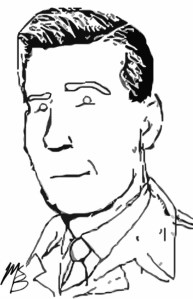
Born on 19 September 1907 in Abbottabad, India, Antony James Dillon Turner was a one-time first-class cricket player and graduate of Royal Military College, Sandhurst. Commissioned with the Suffolk Regiment in 1928, he also served with the West African Frontier Force and in India. He attended staff college at Camberley in 1938 before being posted to the Aldershot Garrison as staff captain. With the outbreak of war in September 1939, Turner was appointed deputy assistant adjutant general with I Corps and participated in the evacuation at Dunkirk for which he earned the Military Cross.
For valuable services during the evacuation of the Dunkirk beaches. This officer showed a fine disregard of his personal safety throughout the evacuation. Always extremely fit, he did an immense amount of hard and dangerous work, showing a fine readiness to face any sort of unpleasant and difficult task without question. He proved himself utterly reliable and steady in most trying circumstances – his coolness being remarkable, and a grand example to the men.
Turner recorded the confusion of the retreat in a diary, writing on 26-27 May 1940: “Dive bombed on my way there. We begin to organise evacuation from beaches which has so far been a mad scramble by all concerned. … on beach day and night except for relief for food and rum and tea! Order to evacuate all except 1st Corps arrives. We are depressed.” Over the next few days, he recorded: “Nearly bumped off by artillery – long range German shell lands near me on beach and kills man next to me. Orders to evacuate all above Lieutenant Colonel arrives. Very depressed! … all evacuation from beaches ceases as Royal Navy withdraw ships. More depressed.”
After safely returning to England, he was posted to the British forces in Nigeria in September 1940 and promoted to acting lieutenant-colonel in December. After nearly two years in West Africia, he returned to the United Kingdom in June 1942 and became general staff officer for Combined Operations Headquarters in Inverary from March 1943. Just weeks after D-Day, he was posted to frontline duty in Normandy on 22 June 1944.
Turner replaced Lieutenant-Colonel R.K. Exham of the 6th Battalion, Duke of Wellington’s Regiment, which had suffered terrible losses during recent fighting. “By now, indeed, there were almost more ‘non-Dukes’ than ‘Dukes’ in the unit,” the battalion second-in-command observed, “… for a few days a surprising variety of cap-badges and shoulder titles were on view. While these newcomers were given a warm welcome, the influx of so many aliens was nevertheless a sad sight to old Dukes.” Turner arrived with no battlefield command experience to a depleted unit filled with new reinforcements. After a disastrous attack near Fontenay-le-Pesnel on 26 June, the battalion reportedly broke in a panic under fire.
Lieutenant-Colonel Denis Hamilton, who later commanded the 7th Battalion, Duke of Wellingtons, recalled in his memoir: “In warfare, you have to accept that mistakes will always be made or things won’t always come off as you hope. If there are, say, three or four adverse things, they will be covered by ten things that go right. But this particular battalion, the 6th Duke of Wellingtons, had about twenty things go wrong … They had suffered a lot of casualties among the officers, and one of the last straws was when the commanding officer’s carrier was seen to be pulling out. Those that were left thought the CO — who was actually visiting the line — had run away. They all ran then” (Editor-in-Chief, 33).
On 30 June, Turner submitted a candid report recommending that the entire battalion be either withdrawn for reorganization or disbanded:
Report on the State of 6th Bn DWR (49 Div) as on 30 Jun
1. I arrived at 6 DWR on the evening of 26 June. From am 27 June until am 30 June we have been in contact with the enemy and under moderately heavy mortar and shell fire.
2. The following facts make it clear that this report makes no reflection on the state of 6 DWR when they left UK:
a) In 14 days there have been some 23 officers and 350 OR casualties.
b) Only 12 of the original officers remain and they are all junior. The CO and every rank above Cpl (except for 2 Lt’s) in Battalion HQ have gone, all company commanders have gone. One company has lost every officer, another has only one left.
c) Since I took over I have lost two second-in-commands in successive days and a company commander on the third day.
d) Majority of transports, all documents, records and a large amount of equipment was lost3. State of Men
a) 75% react adversely to enemy shelling and are ‘jumpy.’
b) 5 cases in 3 days of self inflicted wounds.
c) Each time men are killed or wounded a number of men become casualties through shell shock or hysteria.
d) In addition to genuine hysteria a large number of men have left their positions after shelling on one pretext or another and gone to the rear until sent back by the M.O. or myself.
e) The new drafts have been affected, and 3 young soldiers became casualties with hysteria after hearing our own guns.
f) the situation has got worse each day as more key personnel have become casualties.4. Discipline and Leadership
a) State of Discipline is bad, although the men are a cheerful pleasant type normally.
b) NCOs do not wear stripes and some officers have no badges of rank. This makes the situation impossible when 50% of the Battalion do not know each other.
c) NCO leadership is weak in most cases and the newly drafted officers are in consequence having to expose themselves unduly to try to get anything done. It is difficult for the new officers (60%) to lead the men under fire as they do not know them.Conclusion
a) 6 DWR is not fit to take its place in the line.
b) Even excluding the question of nerves and morale 6 DWR will not be fit to go back into the line until it is remobilised, reorganized, and to an extent retrained. It is no longer a battalion but a collection of individuals. There is naturally no espirit-de-corps for those who are frightened (as we all are to one degree or another) to fall back on. I have twice had to stand at the end of a track and draw my revolver on retreating men.
Recommendation. If it is not possible to withdraw the battalion to the base or UK to reequip, reorganize and train, then it should be disbanded and split among other units. If it is not possible to do either of the above and it is essential that the battalion should return to the line, I request that I may be relieved of my command and I suggest that a CO with 2 or 3 years experience should relieve me, and that he should bring his adjutant and a signals officer with them.
Being a Regular officer I realise the seriousness of this request and its effect on my career. On the other hand I have the lives of the new officer personnel (which is excellent) to consider. Three days running a Major has been killed or seriously wounded because I have ordered him to, in effect, stop them running during mortar concentrations. Unless withdrawn from the division I do not think I can get the battalion to fight normally and this waste of life would continue. My honest opinion is if you continue to throw new officer and other rank replacements into 6 DWR as casualties occur, you are throwing good money after bad.
I know my opinion is shared by two other Command officers who know the full circumstances.
General Bernard Montgomery was unsurprisingly unimpressed and regarded Turner as “not a proper chap and displays a defeatist mentality.” The general nevertheless followed the recommendation and withdrew the 6th Battalion from the division, reassigning reinforcements to the 7th Battalion, DWR. Its place was taken by 1st Battalion, Leicestershire Regiment from the 162nd Independent Infantry Brigade stationed in the United Kingdom.
Despite Turner’s critical self-assessment and request to be relieved in favour of a more veteran commander, he returned to France on 19 July 1944 to take command of 1st Battalion, Hampshire Regiment in the 50th Division. Leading the Hamsphires through the bloody advance into the Low Countries in October, his second tour in command would prove much more successful and he earned the D.S.O.:
Just as the attack started violent and very concentrated artillery fire was brought to bear by the enemy on Lieutenant Colonel Turner’s command post, knocking him down and killing and wounding most of the Officers and men in the command post. It also destroyed all his communications. He soon realised that the command post was under direct observation, and any movement brought more fire. Lieutenant Colonel Turner showed outstanding courage by successfully organising evacuation of the command post under very heavy fire. Knowing that he was temporarily out of touch by signal with his company, he immediately went forward on foot to the forward companies and personally directed the attack. By his outstanding courage and leadership all the Battalion objectives were gained despite intense artillery and mortar fire, and very stubborn resistance by the enemy.
In December 1944, the battalion along with the 50th Division returned to the UK to act as a reserve for reinforcements. In February 1945, Turner left the Hampshires to be GSO1 for Combined Operations Headquarters in India. Promoted to colonel in June, he went on to postings in Burma, Malaya, and Germany over the next five years. After command of a territorial army brigade and assignments to the Middle East, he retired as brigadier in 1958.
He worked for the postcolonial Ghana government as the first national organizer of the Workers’ Brigade until his death in Accra on 4 October 1959.
 World War Graphic History