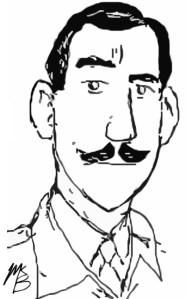
Lieutenant-Colonel T. Hart Dyke
Hallamshire Battalion, York and Lancaster Regiment
It was now getting most difficult to find men to accept the added responsibility and danger of leadership. There was little to offer in return for what one asked of them. Rank and money meant little these days. A dozen times they had escaped improbably. Long ago the few surviving men in the rifle companies had been bound to realize the odds against them remaining unharmed. But the honour and good name of the battalion meant much to them.
(Hart Dyke, Normandy to Arnhem: A Story of the Infantry)
Born on 19 February 1905 in Chaman, British India, Trevor Hart Dyke attended Marlborough College then the Royal Military College at Sandhurst. He took a commission with Queen’s Royal Regiment in 1924 and served with the 2nd Battalion in India and the Sudan. He volunteered with the King’s African Rifles in the 1930s in Keyna and Uganda until he rejoined the Queen’s Regiment in 1936. Having completed staff college at Camberley, he held posts with the War Officer and staff assignments at brigade and division levels.
He commanded the 2/7th Battalion Queen’s Royal Regiment before being appointed commanding officer of the Hallamshire Battalion, York and Lancaster Regiment in late 1943. It landed in Normandy on 9 June 1944 as part of the 49th (West Riding) Infantry Division. For his “leadership powers of command in battle,” he earned the D.S.O.: “Has throughout set a high example of courage and leadership under difficult conditions which has infected all ranks of the Bn and is responsible for the high state of morale and discipline which is evident to any visitor to the Bn.”
Just an inspiring leadership acted as boost to morale, Hart Dyke understood the contagion of battle exhaustion. He wrote in this postwar memoir Normandy to Arnhem: A Story of the Infantry (1966), that medical officers:
… decided to ‘patch up’ these ‘bomb-happy’ cases which we had to evacuate, but I never found one, who, on his return, proved an asset to the battalion. True, they made the unit stronger on paper, but they made it weaker in actual fact, because their nervousness always recurred on going
He relinquished command of the Hallamshire Battalion in March 1945 to Major M.C.K. Halford and took up a staff posting in Burma. He served as GSOI with 7th Indian Division and 11th East African Division. At the end of the war, he commanded the 25th East African Infantry Brigade in India and in 1946 returned to King’s African Rifles in command of the 5th Battalion in Somalia. In 1948, Hart Dyke was appointed commanding officer of 1st Battalion, Queen’s Royal Regiment. He retired from the army at the rank of brigadier in 1958.
He travelled in Africa as a big game hunter and died on 3 June 1995 at the age of 90 in Bamford, Derbyshire.
 World War Graphic History