Lieutenant-Colonel A.W.H.J. Montgomery-Cuninghame
11th Battalion, Royal Scots Fusiliers
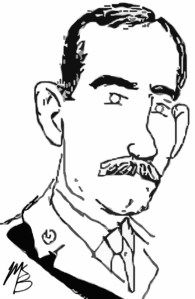
As the name ‘Big Monty’ might imply, Lt.-Col. Montgomery-Cuninghame was an awesome figure. Well over six feet tall and built like a giant, he was a forceful and thrusting leader of the Battalion … Of course, some of the methods he had formulated to attain the present discipline and dedication to the job in hand, had not always met with the instant approval of the rank and file.
(Kenneth West, An’ It’s Called a Tam-o’-shanter)
Born on 28 October 1905 in Chelsea, Middlesex, England, Alexander William Henry James Montgomery-Cuninghame was heir to Baronet of Corsehill. His father Sir Thomas (1877—1945), earned the Distinguished Service Order in the Boer War and his grandfather Sir William James (1834—1897), received the Victoria Cross in the Crimean War. Following the family’s military tradition, the younger Montgomery-Cuninghame took a commission in the Royal Scots Fusiliers.
He succeeded Lieutenant-Colonel W.M. Syfret as commanding officer of the 11th Battalion in June 1942. “We have a lot to learn and not very much time to learn it in,” he told the unit in 1943 as they spent another year training before deploying to Normandy a week after D-Day as part of the 49th Division.
Fusilier Kenneth West recalled “Big Monty” as an imposing disciplinarian who nonetheless gain the respect of his battalion. He wrote that the Colonel’s “constant companions were his huge thumb-stick and his ever faithful dog Bruce. Both had played a part in his disciplinary application.” With Bruce at Montgomery-Cuninghame‘s feet:
Many an unfortunate miscreant vowed that he had been sentenced by the dog and not by the CO, for on some occasions the CO would look at the dog and say “What shall we do with this laddie, eh Bruce?” then depending on how many times the dog wagged his tail, the fusilier would be given one day’s confined to barracks per wag.
… However, since the arrival of the Battalion on the twelfth of June on the invasion beaches, Big Monty had led them with courage and with complete disregard for his own safety.
On 3 July 1944, a mortar shell splinter struck Montgomery-Cuninghame in the chest. He died at the regimental aid post half an hour later. The unit war diary record: “His death came as a great shock to the whole Battalion, whom he had led with such force, determination and lion-hearted in the attack on Fontenay on 25th June, when his conduct was an inspiration to all.”
Major Duncan Arthur Davidson Eykyn, second-in-command of the 8th Battalion, Royal Scots Fusilier took command of the 11th. Continuing the family’s military honours, Montgomery-Cuninghame was posthumously awarded the Distinguished Service Order for leadership in an assault against a German strongpoint a week before his death. Brigadier E.R. Mahoney wrote:
In the course of the bitter fighting which followed & whilst last for a considerable period, Lieut-Col Cuninghame planned each successive stage of his attack most cooly and inspired everyone by his efforts and determination. The successful capture of this vital place was, in my opinion, principally due to the skill and competence of this officer.
After his father’s death in 1945, the baronet passed to Montgomery-Cuninghame‘s half-brother.
 World War Graphic History