Lieutenant-Colonel John Hopwood
1st Battalion, Black Watch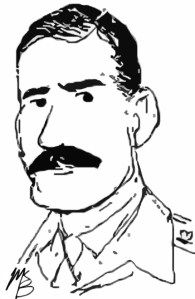
I was standing there on top of this bloody tank and suddenly I felt a red hot pain in my chest and I was on the ground. Horrible noise. And I thought hell … I thought that’s the death rattle isn’t it [laughs] and I thought I was dead. And I felt very sorry for everybody at home, they’d miss me, that sort of thing. And then I realized I wasn’t dead, fortunately.
(J.A. Hopwood, interview, Feb 1987)
Born on 26 January 1910, John Adam Hopwood joined the Black Watch in 1930 after attending Eton College and Sandhurst. “I think I might have gone to the Royal Navy,” he later reflected, “but being me of course I put it off too late – procrastinated— so army was the next best thing.” He served as second-in-command of the 7th Battalion, Black Watch and earned the D.S.O. for heroism at Wadi Akarit in April 1943. When one company wavered after its officers were knocked out, Hopwood took charge of the advance. The citation credited his “actions which were carried out with the highest degree of resourcefulness, courage and determination were undoubtably responsible for the forward Coy reaching its objective.”
He was shot through the lung during the battle and evacuated but returned to duty in time for the invasion of Sicily. After Lieutenant-Colonel C.N.M. Blair of the 1st Black Watch was wounded near the outset of the campaign, Hopwood transferred from the 7th to take over at the end of July 1943. He remained in command for the next two years, one of the only battalion commanders to make it to the end of the campaign in Northwest Europe. Comparing the two theatres, he preferred North Africa “‘cause you went smashing everything up or anybody up, you’re just bashing each other.”
“It came as a rather nasty shock to us,” he recalled of the conditions in Normandy. “The fighting was in closed country. When you were dug in I remember … you used to get these damned shells bursting … they’d burst in trees and scattered and had a very deleterious effect.” For his leadership during Operation Totalize in August 1944, Hopwood earned the D.S.O. Bar: “Lt. Colonel Hopwod’s conduct throughout the whole battle was quite magnificent and was freely commented on by all ranks under his command, particularly those in the supporting arms who had not previous seen him in action.”
He was promoted to brigadier after the war with postings in Germany, Iraq, Hong Kong, and Egypt before retirement in 1958. He recorded an interview about his wartime experiences for the Imperial War Museum months before his death on 31 July 1987.
 World War Graphic History