Lieutenant-Colonel George Dunn
2nd Battalion, Seaforth Highlanders
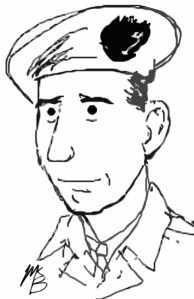
Major Dunn as Bn 2nd in command was with me at the former Bn HQ. As bn HQ was about to advance it was shelled and many personnel were casualties … I was wounded also. Maj. Dunn was a tower of strength during that crisis and throughout the rest of the night. He re-organised a scratch Bn HQ, re-organised communications, re-organised people to deal with casualties, and by his calmness and coolness in very difficult circumstances was of outstanding help in getting things going again.
(D.S.O. Bar citation, 21 Dec 1944)
Born in Lanarkshire on 27 March 1914, George Willoughby Dunn was a graduate of Glasgow University, a solicitor and Territorial Army officer, commissioned into Royal Scots Fusiliers in 1935. He served with the 5th Black Watch as a company commander in North Africa and was wounded at the Second Battle of El Alamein in October 1942. He then earned the Military Cross for leading an assault on a hill strongpoint at Wadi Akarit in April 1943: “He exposed himself continuously without fear for his own life and his complete disregard for his own safety made possible the taking and holding of this feature. Throughout Major Dunn has been an inspiration to all who serve under him.”
During the invasion of Sicily in July 1943, he secured a key brigade against enemy counterattack, which earned the D.S.O.: “Major Dunn used every effort to encourage his troops and to organise the defence. He was painfully wounded but refused to give in and undoubtedly by his personal bravery contributed greatly to the success of the action.” By the invasion of France in June 1944, Dunn was second-in-command of the 5th Black Watch.
For leadership during the heavy fighting on 18/19 August, he received the D.S.O. Bar. After battalion headquarters was shelled and Lieutenant-Colonel Bill Bradford was wounded, Dunn took charge to get the unit moving again. Bradford wrote in his recommendation: “His personal example was an inspiration to all. Throughout the night Major Dunn worked untiringly under fire at getting up the essential fighting vehicles to the Bn.”
In March 1945, Dunn took over the 2nd Seaforth Highlanders from Lieutenant-Colonel G.L.W. Andrews, who had commanded since July 1943. Dunn led the battalion through to the end of the war in Europe. Major Martin Lindsay of 1st Gordon Highlanders, wrote in his diary: “He’s been two and a half years a second-in-command, during which he has collected two D.S.O.’s and an M.C. So it was high time he got promotion.”
Dunn returned to his civilian career as a lawyer but remained active in the Territorial Army. He was colonel of the 4/5th Black Watch in 1954, then commanded a brigade until retirement in 1960. For his efforts to sustain the postwar Territorial Army and promote recruitment he was made Commander of the Most Excellent Order of the British Empire in 1959.
Dunn died in Monifieth on 1 April 1994.
 World War Graphic History