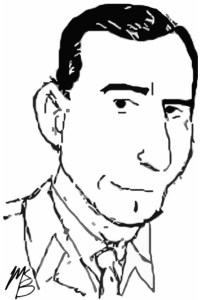
Lieutenant-Colonel Tony Arengo-Jones
1/4th Battalion, King’s Own Yorkshire Light Infantry
Commanders at every level up to battalion will be required to pay attention to such tactical principles as the need to bring maximum, accurate fire on enemy positions from as many different directions as practicable; bold flanking and infiltration movements undertaken whenever the circumstances are propitious; reducing the risk of casualties by having as few men as possible moving in the attack at any one time, and the employment of deception to conceal the direction from which the final assault is launched
(Arengo-Jones, “An Exchange of Ideas,” Infantry, Sep-Oct 1966, 6)
Born on 17 August 1915 in Somerset, Gloucestershire, Anthony James Arengo Arengo-Jones was a graduate of Cheltenham College and rugby player. After attending Royal Military College, Sandhurst he took a commission with the Gloucestershire Regiment in 1936. He served at Dunkirk in command of an anti-tank company. He returned to France after the Normandy invasion as brigade major with the 160th Infantry Brigade.
He joined the 2nd Battalion as second-in-command at the end of August 1944 but was wounded the next month. He soon resumed his post, and served as temporary CO in late 1944. In January, Arengo-Jones transferred to 1/4th Battalion, King’s Own Yorkshire Light Infantry, succeeding Lieutenant-Colonel T.W.A.H. Harrison-Topham in command. The regimental history noted that the new CO “earned the reputation of being an ubiquitous commanding officer, clad either in a white rabbit-skin jerkin or in a sniper’s jacket.”
His tenure, however, would be brief. He was accidentally but badly wounded by a grenade blast in February, losing an eye. He was replaced by Lieutenant-Colonel M.B. Jenkins. In the postwar army, Arengo-Jones saw service in Northern Ireland, Jamacia, Kenya during the Mau Mau rebellion, Cyprus, and Bahrein. He was promoted to brigadier in 1962.
He was commandant of the school of infantry at Warminster from 1964 to 1967 and then fortress commander at Gibraltar before retiring from active service in 1970. He was appointed colonel of the Gloucestershire Regiment from 1971 to 1979.
He died in Ashton Keynes on 28 January 1997.
 World War Graphic History