Lieutenant-Colonel Jeff Nicklin
1st Canadian Parachute Battalion
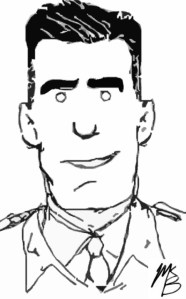
Colonel Nicklin was a by the book commander, absolutely no quarter given and he had no compassion for defences that were mounted … the number of soldiers punished severely for what might be minor infractions gave the colonel the un-kind title of ‘Tyrant.’”
(Quoted in Bernd Horn, Intrepid Warriors, 240)
Born in Winnipeg on 10 December 1914, Jevon Albert Nicklin was a football player for Winnipeg Blue Bombers and won the Grey Cup with the team in 1935 and 1939. He was commissioned second lieutenant in August 1940 and joined the Royal Winnipeg Rifles before volunteering to be a paratrooper two years later. He became second-in-command of the 1st Canadian Parachute Battalion where he earned a reputation as a disciplinarian, “tough as hell”
After a year and a half of training, the unit prepared for the invasion in Normandy as part of 3rd Parachute Brigade. In March 1944, the British brigade played a rugby match against a team from the U.S. Army. Hoping to capitalize on his sport stardom, the British hoped to enlist him in the match. Lieutenant-Colonel G.F.P. Bradbrooke “felt that too much was at stake at this time for Nicklin to play rugby as it might jeopardize his whole future.” Nicklin agreed, arguing that “A very slight strain or sprain (inconsequential in another arm of the Service) would put him out of a Para Bn … a few months ago, or if operations were not so imminent, he would have liked nothing better.” Nevertheless, he was tackled heavily in a 15 March match, fracturing his right clavicle.
He recovered to drop with the unit on D-Day. He landed isolated and off target behind enemy lines with his parachute tangled on a roof. Evading German defenders in Varaville, he described a chaotic situation on the ground: “They ran around that town like crazy me and shot at anything that moved. Even a moving cow would get a blast of machine gun fire. They were so jumpy they ran around in twos or threes to give themselves moral support.” He was put out of action after suffering shrapnel wounds at the end of July.
After recuperation, he assumed command of the battalion in September 1944 as it recovered and training following Normandy campaign. Nicklin’s command style and reputation as a martinet caused growing friction and resentment among the troops. On 22 October, many took part in a hunger strike to protest the CO’s methods. Brigadier James Hill of 3rd Parachute Brigade intervened to calm the situation by appealing to the troops’ pride and patriotism. For his part, Nicklin remained steadfast in his harsh discipline.
“He didn’t change from lugging a football to lugging a tommy-gun,” Major G.F. Eadie said of his commander. The battalion returned to Northwest Europe in December 1944, in time for the German Ardennes offensive. On 17 February 1945, Hill assessed Nicklin’s performance as very satisfactory, writing:
An officer of the highest integrity who possesses unusual drive and determination. He sets a very high standard in the Bn and is prepared to accept no comprise. He is a stern disciplinarian but takes infinite trouble to safeguard the welfare of the men. He is a good trainer of troops and is tactically wound in his ideas. He requires further experience in the tactical handling of his Bn.
Just over a month later, Nicklin’s body was found with his parachute dangling from a tree. An investigation determined the circumstances of death: “All aircraft arrived punctually over the dropping zone at 1000 hrs 24 Mar 45. Lt -Col Nicklin, who was number seven or eight in his stick, jumped without incident, but, unfortunately, his parachute became entangled in a tree. Before he had time to extricate himself he was fired upon and it would appear that death was instantaneous in that he had been hit many times by machine gun and rifle fire.”
The battalion donated the Jeff Nicklin Memorial Trophy to the Western Interprovincial Football Union for the 1946 season. It continues to be awarded to the most outstanding player in the West Division of the Canadian Football League.
 World War Graphic History