Lieutenant-Colonel G.F.P. Bradbrooke
1st Canadian Parachute Battalion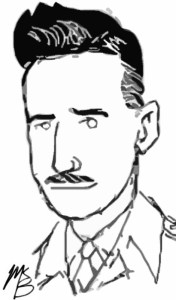
No matter how many jumps a fellow makes, he’s scared. He jumps from a height of 400 feet, and has about nine seconds to reach the ground. There isn’t time to make mistakes.
(Quoted in Star Phoenix, 25 Sep 1942, 3)
Born in Yorkton, Saskatchewan on 14 March 1912, George Frederick Preston Bradbrooke was a graduate of the University of Saskatchewan and an accountant in Regina. The son of a First World War colonel, he was also nephew of Brigadier G.R. Bradbrooke of 5th Armoured Brigade. He mobilized with the Saskatoon Light Infantry in 1939 and participated in the bloodless Spitzbergen raid of August-September 1941.
With a promotion to major, he volunteered for the newly formed 1st Canadian Parachute Battalion and underwent training in England. At thirty-years old, he became the youngest battalion commander of any Canadian formation in October 1942. Two months later, the battalion set up headquarters in Fort Benning, Georgia, where his predecessor Major Hilton D. Proctor had been killed in a jump accident on 7 September.
In July 1943, the battalion departed for the United Kingdom where it became part of 3rd Parachute Brigade, British 6th Airborne Division. After another year of training, the 1st Canadian Parachute Battalion was dropped in Normandy on the morning of 6 June 1944 hours ahead of the D-Day landings.
During the fighting over the next three months, Bradbrooke proved less effective as a combat leader. Soldiers felt “he should have been assigned to a desk” and superiors worried he showed signs of nerves. Brigadier James Hill of 3rd Parachute Brigade judged him as a “good administrator, a very good CO in peacetime and an intrepid parachutists.” On 23 August, Bradbrooke was relieved and posted to Canadian military headquarters in London. He was temporarily replaced by Major G.F. Eadie until the battalion returned to England. In September 1944, Major Jeff Nicklin assumed command.
In an interview decades later, veteran Bob Carlton described Bradbooke as the “black sheep” of the battalion before he was “kicked upstairs,” and then largely forgotten in the annals of Canadian airborne troops. Carlton felt superiors had replaced him because Bradbrooke “wasn’t inspiring enough VCs.”
He retired from the army in May 1946 and eventually moved to England. He died in London on 14 December 1993.
 World War Graphic History