Lieutenant-Colonel Geoffrey Pine-Coffin
3rd Parachute Battalion,
7th (Yorkshire) Parachute Battalion
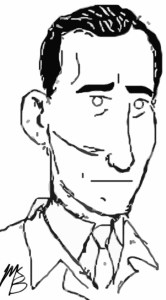
Lieutenant-Colonel Pine Coffin, he was—and I’m not saying this because I’m being taped—he was the finest officer that any man can wish for … He was for the men. He wasn’t one of those ‘oh because I’m an officer, I’m above you’ … He never degraded you.
(Walter Tanner, IWM interview, 31 Jul 1990)
Born on 2 December 1908 in Portledge Manor, Bideford, Devon, Richard Geoffrey Pine-Coffin graduated from Eton and Trinity College, Cambridge. He was commissioned into the Devonshire Regiment in 1928 and mobilized with the 2nd Battalion, Duke of Cornwall’s Light Infantry. He served in the Battle of France and after Dunkirk joined the 11th Devons as a major. His compound family name led soldiers to dub him “Wooden Box” as the dead were typically buried in simple coffins made of pinewood.
After the formation of the British airborne forces in 1941, Pine-Coffin volunteered to be a paratrooper. He served as second-in-command of the 3rd Parachute Battalion and took command in October just before the Allied landings in North Africa as a part of Operation Torch. Fighting throughout the campaign in Tunisia, Pine-Coffin earned the Military Cross: “Flying out from the U.K., he led his command with the utmost gallantry during the Parachute drop on Bone Aerodrome. Distinguishing himself at the battle for Green Hill (Sedjenane sector) in January 1943 whilst under command of the 36 Brigade, he earned praise from the Commander for his energetic devotion to duty and daring reconnaissance.”
Pine-Coffin was recalled to the United Kingdom before the invasion of Sicily in July 1943 to help build and train the newly formed 6th Airborne Division. He was posted to the 7th Parachute as second-in-command in October and then succeeded Lieutenant-Colonel N.H. Barlow in March 1944. Pine-Coffin led the battalion in the drop over Normandy in the early morning of 6 June and earned the Distinguished Service Order for the capture of Pegasus Bridge.
He displayed great courage and leadership over the three months in combat. After the withdrawal of the 6th Division in September, he returned to the field at the beginning of 1945. At the Battle of Hamminkeln on 27 March, Pine-Coffin was wounded in the face which left him with a scar, but he remained on duty. “Inspired by their Colonel’s outstanding example and gallantry,” the D.S.O. Bar citation read in part, “his battalion held their isolated position in the face of strongly pressed counter attacks until the brigade objective was completely secured and consolidated, after which he was called on to withdraw into it which he did successfully bringing large numbers of prisoners with him.”
After the end of the war in Europe, Pine-Coffin and the 7th Battalion transferred to the Far East and earned a mention in despatches in Burma. After Japan’s surrender in August, he led the unit to Palestine, where he served until 1947. He then returned to the Devonshire Regiment, commanding the 1st Battalion in Malaya from 1948 to 1951. He next served as colonel of the Parachute Regiment until 1955 and retired from the army three years later.
He died on 28 February 1974 in Gosport, Hampshire.
 World War Graphic History