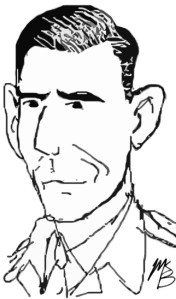
Lieutenant-Colonel Terence Otway
9th Parachute Battalion
The more I think about it the more I wonder how in the devil we did it … It was this fantastic training that saved us. I can’t believe we could have pulled it off otherwise … It was an appalling shambles and only Good knew what lay in store for us. I asked myself, do I pack up or do I go on? It had been stressed to me how vital it was to see the thing through. So I really had no option but to have a go.
(Quoted in Brimingham Post, 6 Jun 1969, 24)
Born on 15 June 1914 in Cairo, Egypt, Terence Brandram Hastings Otway was educated at Royal Military College, Sandhurst and took a commission with 2nd Battalion, Royal Ulster Rifles in 1934. He served overseas in Hong Kong, Shanghai, and on the North West frontier in India. Following staff college and War Office duties in London, he transferred to the airborne forces in August 1943 and later became second-in-command of the 9th Parachute Battalion under Lieutenant-Colonel Martin Lindsay. Just months before D-Day, Otway had taken commander under inscrutable circumstances.
It was well known in the battalion that Lindsay and Otway never got along. Some officers suspected Otway desired command himself and had conspired to remove Lindsay. The chance evidently came in March 1944, when Lindsay was placed under arrest. He disclosed that the battalion would be desisted for France in a casual conversation, in the presence of Brigadier James Hill. He was court martialed and convicted for the security breach but only reprimanded. Lindsay did not return to the paratroops but by July 1944 he would be posted to 1st Gordon Highlanders in Normandy as second-in-command.
Otway took over the 9th Parachute and would be promoted to lieutenant-colonel in April. Intent on testing his men’s discretion, Otway initiated an idea to recruit Women Auxiliary Air Force personnel to see if they could elicit any secret information or security breaches. “Much to my surprise,” he stated, “no violations were reported. I wondered if some of the WAAFs became real girlfriends.”
On 5 June 1944, his battalion dropped in Normandy behind enemy lines. His transport was struck by antiaircraft fire, and Otway was thrown out before he could jump. “It didn’t kill anyone,” Otway recalled, “but it blew a great big hole in the fuselage of the plane and certainly encouraged my men to get out of the plane fairly quicky.” Despite mistargets and many other difficulties on the ground, Otway secured his objectives and earned the D.S.O.:
For conspicuous bravery and outstanding leadership. This officer led 150 men of his battalion on the successful attack of the Sallenelles battery. He personally directed the attack and organised the successful cleaning up of the enemy strong points under heavy enemy mortar and machine gun fire. He led the attack on and successfully held Le Plein until relieved by another formation. On arrival in the Le Mesnil area he succeeded in beating off two major enemy attacks of several hours duration by his magnificent leadership of his numerically very weak and tired battalion. His utter disregard of personal danger has been an inspiration for all his men.
After the D.S.O. was stolen in 1969, Otway declared, “I am very upset about losing the medal, because it was not presented just to me but for all the chaps who took part and died in the raid.”
Shortly after landing in Normandy, Otway was concussed by a shell blast and began suffering headaches and blackouts. “What had happened, I got knocked out,” he recounted in an interview decades later. “I woke up … with a terrible headache. And I was –how should I put i–muzzy for the next few weeks and I had increasing pain in the left side of my head and neck, shoulder, and arm until eventually in one conference I lost my sight.”
He was hospitalized and relieved by Lieutenant-Colonel Napier Crookenden on 19 July 1944. “I was furious of course but there was nothing I could do about it,” Otway said. He ended the war in Europe as a staff officer in London and then went to the Pacific theatre where to took command of 1st Battalion, King’s Regiment (Liverpool) in May 1945. He resigned his commission in 1948.
In civilian life, Otway worked in a range of fields from general manager of the Colonial Development Corporation, life insurance, managing director of the Empire News, import/exporting, headhunting, and investments. In retirement, he was active in promoting the history of the Parachute Regiment and advocated on behalf of veterans and servicemembers.
He died in Tadworth on 23 July 2006.
 World War Graphic History