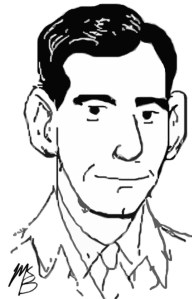
Lieutenant-Colonel Jock Pearson
1st Parachute Battalion
8th (Midlands) Parachute Battalion
I do not believe that there is any man, who, in his heart of hearts, would not rather be called ‘brave’ than any other virtue attributed to him. This elemental and reasoning attitude is a good one. Because courage is not merely a virtue but is THE virtue. Without courage, there are no other virtues. Faith, hope and charity, and all the rest, don’t become virtues unless you have the courage to exercise them.
(Pearson lecture quoted in Julian James, A Fierce Quality, 118)
Born on 1 June 1915 in Glasgow, Scotland, Alastair Stevenson “Jock” Pearson was educated at Kelvinside Academy and worked as a baker during the Great Depression before joining the Territorial Army. He rose to become one of the youngest battalion commanders in the British Army. “Gentlemen, do what you are told and stay alive,” he would stress to his officers. “Remember, there will be no bloody medals in this battalion.” Yet with four D.S.O.’s and one Military Cross, Pearson ended the war as one of the most highly decorated officers.
Pearson served with the Second British Expeditionary Force before the fall of France in June 1940. He stayed behind after the evacuation for sabotage and then made his own escape across the Channel. Assigned to mundane guard duty once back in the United Kingdom, he volunteered for the British airborne forces. By spring 1942, he was second-in-command under Lieutenant-Colonel James Hill of the 1st Parachute Battalion, which participated in the invasion of Tunisia in October 1942. Hill later recalled:
Alastair excelled—his Scottish canniness stood him and us in good stead. I was presented with no major problems and some peace of mind. Alastair realized, as well as I had done, that in wartime Second-in-Command was a very strategic position, for Commanding Officers did not seem to survive long and there was always the problem of removing the temporary incumbent, as will be seen later in the story.
A month later, after Hill was wounded, Pearson took command of the 1st Battalion. “He continued to command his unit throughout the subsequent fighting,” his Military Cross citation read, “and by his leadership and coolness under fire set an example of the highest degree.” To his M.C. he soon added a D.S.O.
He earned the Distinguished Service Order for a raid at Djebel Mansour in January 1943 and an attack the next month: “Throughout the whole operation this officer fearlessly led his Battalion and, by his example and utter disregard for his personal safety, was an inspiration to all ranks. By his skilful handling and courage he was able to evacuate all his men. On one occasion he, single-handed, destroyed an enemy machine gun post which was causing severe casualties.”
For defeating a German attack at Tamera in March 1943, Pearson earned a D.S.O. Bar: “Without hesitation and under intense fire he organised counter attacks and by his brilliant leadership and bravery on all occasions, restored the position, killing large numbers of the enemy and forcing some 150 to give themselves up. Attacked again on 10th March he personally led his Battalion HQ staff of clerks and cooks against the enemy who was attacking from the rear of his Battalion HQ. Inspiring all with his great bravery and leadership he completely defeated all efforts of the enemy to penetrate his positions, personally killing many of the enemy and capturing further prisoners.”
By the end of the North African campaign, Hill recalled that Pearson’s “personal courage and example made him a legend in his own time.” He lead the 1st Battalion in Sicily, earning a second D.S.O. Bar: “He and his Battalion were widely scattered, but he collected all the men he could find and led a successful attack on the main objective. Throughout the battle, which included counter attacks, he displayed courage and leadership of the very highest order. When his Battalion was withdrawn from the battle, he remained with 151 Infantry Brigade in order to give them the benefit of his local knowledge, which he usefully employed during an attack on the following night.”
Stricken with malaria, Pearson needed to be evacuated to North Africa shortly thereafter until being sent home a few months later. Back in the United Kingdom, in November 1943, Brigadier Hill appointed a recovered Pearson to command 8th Parachute Battalion, a Royal Warwickshire Regiment unit converted to airborne, and “knock it into shape.” Pearson later spoke of the intense methods: “Before D-Day in 8th Parachute Battalion, during the live firing in training, we killed or wounded something like ten people. Nothing was ever said because, while we were taking risks, we were taking what were considered very reasonable risks. But I am sure that this realistic training saved countless lives later on when we went to France.”
During Operation Tonga, the battalion landed just prior to D-Day as part of Hill’s 3rd Brigade. Although wounded early on, he reorganized the scattered unit and carried out his objectives. For his leadership, he received a third D.S.O. Bar:
Lieutenant-Colonel Pearson conducted the battle personally through the whole attack and was tireless in his visits to the forward companies. When the enemy, supported by self-propelled guns, started to penetrate between the forward positions, he moved forward with the counter attack force handling his own men and 17 pounder self-propelled gun with such success that the enemy infantry and self-propelled guns were forced to withdraw in some disorder. Throughout the day he moved amongst his troops under artillery, heavy mortar and machine-gun fire and his conduct was an inspiration to the whole Battalion.
Due to lingering effects of malaria contracted in Sicily compounded by sickness, Pearson relinquished command after the battalion returned to the UK in late 1944. Command passed to Major George Hewetson. Brigadier Hill later reflected:
His parting was a sad day for me. We had been comrades in arms for three years and I was now to lose a loyal and valiant friend. I realized I should miss him greatly in the battles that still lay ahead. It is unfashionable to talk of love in military circles but love is as potent a factor in war as it is in peace. Alastair was a fighting commander who loved his soldiers and in consequence they loved him.
In civilian life, Pearson returned to baking before taking up farming and resumed service with the Territorial Army. In addition to other honours and titles, he was the ceremonial aide-de-camp to the Queen from 1958 to 1961.
Pearson died on 29 March 1996 in Gartocharn, Dunbartonshire, Scotland.
 World War Graphic History