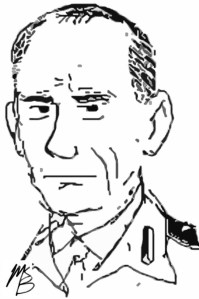
Colonel Wladyslaw Dec
3rd Rifle Brigade
‘To hell with women just now — what I need is a bridge! Report your discovery to the General.’ I shouted somewhat un-gallantly. I forgot that the world is small and while a mountain might not meet up with another, people are in fact likely to meet again. Also, I didn’t think that one day people would remember that I preferred a bridge to women.
(Quoted in Dec, Narvik and Falaise, 377-9)
Born on 13 February 1898 in Sokołów Małopolski, Władysław Dec was drafted into the Austro-Hungarian Army during the First World War and was commissioned a second lieutenant in 1916. He joined the newly formed Polish Army in November 1918 and fought during the wars of independence. After the September 1939 campaign, Major Dec escaped with his brigade to France via Hungary and the Balkans.
After commanding a battalion in the Battle of Narvik in spring 1940, he then became commanding officer of 1st Podhale Rifle Battalion as part of the reconstituted Polish forces in the United Kingdom. When the 1st Armoured Division deployed to Normandy in July 1944, Dec served as deputy commander of the 3rd Rifle Brigade. He earned the Distinguished Service Order in the campaign:
Commanding 3rd Infantry Brigade on 3rd and 4th September 1944, during the fighting for Abbeville, France, Commanding 3rd Infantry Brigade, by personnel example and devotion to duty, being the whole time in the front line in spite of extremely heavy mortar and MG fire. Gained success by seizing the crossing over the River Somme that enabling the Division to maintain the pursuit. The Brigade command, during the last months of the war has always brought success to the Brigade.
Promoted to colonel, Dec succeeded Franciszek Skibinski in command of the brigade in January 1945, and served until the end of the war. When Colonel Koszutski reported the discovery of a German POW camp with 1,700 Polish female prisoners from the Warsaw Uprising, Dec prioritized the capture of a key bridge. He later wrote:
But to return to the bridge problem, having ‘ticked off’ Col. Koszutski for his report about the women prisoners I jumped into a scout-car and raced to the canal. Along the way, jointly with Col. Complak, I drew up a plan to capture and secure Ter Apel …
He who risks nothing gains nothing,’ I said, ordering a squadron of Sherman tanks to cross the bridge. And, wonder of wonders, a bridge designed for a one-tonne load survived the weight of twelve thirty-tonne tanks; it settled down in the canal only under the thirteenth tank which was commanded by the squadron leader.
Following service in the occupation of Germany, in 1947, Dec returned to Poland where he worked as a teacher. From 1957 to 1961, he conducted research for the Polish Army Historical Office. He published a memoir of his war experiences titled, Narvik and Falaise in 1958.
Dec died in Warsaw on 21 November 1965.
 World War Graphic History