Lieutenant-Colonel Karol Complak
1st Podhale Rifles Battalion
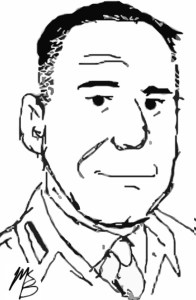
Without Lieutenant Colonel Complak’s presence, this attack on very heavily defended enemy’s position, would have been very costly, both in men and time lost. Throughout the fighting in France, Belgium, Holland and Germany, Lieutenant Colonel Complak has shown great coolness and personal bravery and been an example of true Soldier’s bravery on the Battlefield.”
(D.S.O. citation, 28 June 1945)
Born on 20 November 1899, Karol Józef Complak was a veteran of the First World War, having served in the Polish Legions while attached to the Austrian Army. By November 1918, he joined the newly created Polish Army and participated in the Polish–Ukrainian War then the Polish-Soviet War. A major by the outbreak of the Second World War, he escaped into Romania then made his way to France.
He commanded an infantry battalion before the fall of France, then trained with a parachute brigade in the United Kingdom. Too old for the paratroopers, in December 1943, he was appointed commanding officer of the 1st Podhale Rifles Battalion, which went to France attached to 3rd Infantry Brigade, 1st Armoured Division. For his leadership in the Northwest Europe campaign, Complak earned the Distinguished Service Order:
On 12th April 1945 in the Tange-Onstwedde, Holland, the 1st Infantry Brigade attacked a strongly defended enemy position under extremely heavy enemy fire. Lieutenant Colonel Complak seeing that our attack was held up by enemy fire, put his command post in the area of the forward company, and despising the personal danger, commanded and co-ordinated the attack of the leading company’s. With the support of the self propelled guns, which were playing the part of infantry support tanks, thus making it possible for the attack to go forward. In this way, being in the fore front of the attack and giving a fine display of bravery and coolness, Lieutenant Colonel Complak stormed with his men the first row of houses in Tange. In no time the localities of Tange and Onstwedde were taken, the enemy had heavy losse. 70 Killed and more than 100 prisoners. Our losses were exceedingly small.
He died in London on 11 December 1967.
 World War Graphic History