Lieutenant-Colonel Martin Lindsay
9th Parachute Battalion
1st Battalion, Gordon Highlanders
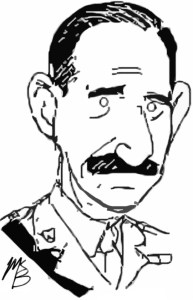
I rise with trepidation and ask for the traditional indulgence of the House. In the course of the last 18 months I have had the honour of commanding an infantry battalion in sixteen operations, and anyone who has had that experience will be familiar with the agonies of apprehension before and after zero hour, but, Mr. Speaker, I am convinced that, for sheer misery, there is nothing to touch the suspense of waiting to catch your eye for the first time.
(Martin Lindsay, Hansard, 7 Nov 1945)
Born on 22 August 1905 in London, Martin Alexander Lindsay was a Scottish noble and explorer. After adventures to West Africa, the Congo, and the far North, he led the British Trans-Greenland Expedition in 1934. After attending Royal Military College, Sandhurst in 1925, he had been commissioned in Royal Scots Fusiliers but retired from the army in 1936 when named Conservative Party candidate for the riding of Brigg. The outbreak of the Second World War paused his political career, and he rejoined the army. Given his arctic experience, he served as a staff officer during the Norwegian campaign in April 1940.
After the evacuation of British forces from northern Norway, Lindsay criticized the government’s strategy which he called “one of the most complete disasters in our military history.” His report to Opposition Labour leader Clement Atlee contributed to the Norway Debate in parliament that resulted in the House of Commons’ vote of no confidence against Prime Minister Neville Chamberlain. Earlier, Lindsay stood down as a candidate in Brigg. As his wife noted, “My husband is afraid the war will last at least five or six years.” Although bound by a duty as an officer to not involve himself in political matters, he wrote in his Norway report, “but I consider that the truth should be made known in the public interest and not buried.”
Lindsay afterwards helped to pioneer parachute warfare and served as the first commanding officer of 151st Parachute Battalion in India. In April 1943, he was appointed to take over 9th Parachute Battalion, part of the 6th Division Airborne Division. Nicknamed Polar Joe, Lindsay proved to be a respected but hard-driving commander. Friction with his second-in-command Major Terence Otway and his own outspokenness, however, ultimately led to his removal almost a year later. In March 1944, Lindsay was suddenly placed under arrest for a security breach. He had disclosed that the battalion would be destined for France in a casual conversation in the presence of Brigadier James Hill. He was tried and convicted by general court martial but would be only reprimanded.
The 9th Parachute Battalion under Lieutenant-Colonel Otway dropped into France on 5 June 1944. Sidelined, Lindsay meanwhile waited over a month for a posting. In mid-July, he was appointed second-in-command of the 1st Battalion, Gordon Highlanders. On landing in Normandy, Lindsay recorded in his diary: “The story of the D-Day battle was still written in the sand for all who could to read … There had been casualties, for in several places one saw a more or less complete set of accoutrements— steel helmet, rifle, web equipment and so on — and alongside it the outline of the stretcher where it had been placed while the stricken man was lifted on to it.”
Even before reporting to his new battalion, Lindsay heard “a sudden swish and a bang, and a shell landed right in the middle of the orchard, causing nine casualties. Every three or four minutes for the next half-hour something landed pretty dose. ‘God Almighty!’ I thought to myself, “if this is a rest area, how can I ever stand the real thing?” He served under Lieutenant-Colonel Harry Cumming-Bruce, a CO he grew to deeply respect. Before the end of July, Lindsay temporarily took over the 5/7th Gordon Highlanders until a replacement arrived for the wounded Lieutenant-Colonel “Scrappy” Hay.
Lindsay served as second-in-command of the 1st Gordons throughout the Northwest Europe campaign but frequently took over in action while the senior officer was on leave or posted to brigade headquarters. One day in January 1945, Cumming-Bruce’s successor Lieutenant-Colonel J.A. Grant-Peterkin, learned he had been ordered to go to leave before an attack. Lindsay wrote of their conversation:
As he said to me: “I am sent here to get practice in commanding a battalion in battle. I am not allowed to go on leave for six weeks while nothing happens. Then the day before an operation starts, I am sent on leave!”
I replied that I quite saw his point, but he could hardly expect me to s3nnpathise as he knew I like commanding the Battalion, and especially in battle.
Lindsay’s diary, published in 1946, chronicled how the prolonged strain and burden of command affected his personality and outlook. On 7 February 1945, he recorded prior to Operation Veritable:
Am very strung up to-night, wondering what the morrow will bring forth. I have often wondered what exactly influences the state of one’s nerves. Sometimes before riding in a chase or making a parachute drop or a speech, I have been very much on edge, without actually feeling precisely frightened; at other times, for no apparent reason, I just haven’t cared a damn. Perhaps it is something to do with one’s liver! Anyway, I’m feeling too restless to write more to-night.
For his command of the 1st Gordons during the operation, while Grant-Peterkin was acting brigadier, Lindsay would receive the Distinguished Service Order. He wrote of the night he learned the news:
I was woken in the night by a signaller with a message pad. I think I must have been dreaming that I was commanding the Battalion in a battle, because I woke with the fixation that this was an order to attack at short notice. But instead it read: ‘30 Corps to I Gordons. Personal from General Horrocks to Major Lindsay. Congratulations on well-deserved award of D.S.O.’ Of course, I was astonished. It is about two years since anything really nice has happened to me. In the next hour I turned on my torch several times just to make sure I’d made no mistake.
After reading a review of Lord Moran’s Anatomy of Courage (1945), which outlined his psychological theories about bravery and breakdown, Lindsay wrote: “How right he is!”:
I can quote my own case too. Until a month or two ago, though I hated being shelled, I used positively to look forward to the thrill of battle. Now, though I have not yet got to the stage of dreading an action, I get no pleasure out of it and look forward only to the end of the war, I shall be particularly glad when this operation is safely over as it is certainly the most difficult we have had since the original Normandy landings.
Lindsay admitted in a March entry, “It is so easy to shirk a little when you are the battalion commander. The truth is that I am not half the man I was six or even three months ago and seem to have lost all my old dash.” By the end of the war in Europe, after last nine months in the field, Lindsay concluded his diary by reflecting on the inexorable casualties to friends and comrades:
I do not believe that anybody can go through a campaign with such men as these, and watch them be killed one after the other, and know that their joyous personalities are now but blackened, broken corpses tied up in a few feet of army blanket under the damp earth—and remain quite the same. For my part I feel that this has made a mark upon me that will never be effaced. It is as if some spring deep down inside me has nm down.
In the June 1945 general election, Lindsay was elected Conservative MP for the riding of Solihull. His maiden speech addressed the threat of the nuclear arms race and atomic warfare, arguing, “So the position today is that the world has embarked upon another arms race and one which will have consequences a thousand times worse than the last one if it is not arrested. We in these small, densely populated islands are bound to be obliterated if this atomic bomb race reaches its logical conclusion.” He held the seat in the House of Commons for the next twenty years, retiring when he did not contest the 1964 election. Two years earlier, he had been made Baronet of Dowhill in the County of Kinross.
Lindsay died in Surrey on 5 May 1981.
 World War Graphic History