Lieutenant-Colonel J.A. Grant-Peterkin
15th Scottish Reconnaissance Regiment
1st Battalion, Gordon Highlanders
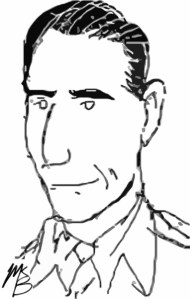
Grant-Peterkin is a tremendous success as C.O. He has personality, brains and charm, but above all, drive and enthusiasm. He is a tall, well-built man with sharp features and very blue eyes, clean-shaven, and fair hair brushed nearly straight back.
(Martin Lindsay, So Few Got Through, 148)
Born on 15 September 1909 in Kinloss, Moray, Scotland, James Alexander Grant-Peterkin was a cricket player and commissioned officer in the Queen’s Own Cameron Highlanders since 1929. He served as brigade major with 4th Infantry Brigade with the British Expeditionary Force in 1940 and was then posted as an instructor to the staff school at Camberley. He was appointed to command 15th Scottish Reconnaissance Regiment in February 1943.
According to the regiment’s history, Grant-Peterkin brought “a tremendous capacity for work, definite ideas on training, a determination to make a crack regiment, a blackened pipe and a habit of brushing his hair as an antidote to fatigue and stress in exercise and action. Working harder and longer than anybody else in the regiment, he was to dominate its life in preparation for battle and in battle for nineteen months and in three countries” (Scottish Lion on Patrol, 13).
He commanded the 15th Scottish when it went ashore in Normandy near the end of June 1944. A subsequent D.S.O. citation read in part: “His leadership has always been of the highest order and his handling of his Regiment has at all times been excellent. The results achieved to date by his Regiment are largely to his own personal courage and example.” On being appointed general staff officer with 43rd Wessex Division in September, he announced to the regiment:
I have been ordered to relinquish command of the Regiment and return to the Staff. In this my final order I wish to thank all ranks for their very real and loyal cooperation and help which have always been extended to me, and to wish you good-bye and good luck … we have been a happy family in which everyone did his best, and it has been easy through all your efforts to achieve success. We have had our trials and tribulations, but when the time for judgement came we were able to show to all and sundry how well we could do.
Major K.C.C. Smith, second-in-command since January 1944, took over the 15th Scottish. Grant-Peterkin’s staff appointment would be brief as by the end of November 1944, he had been assigned to command 1st Battalion, Gordon Highlanders, replacing Lieutenant-Colonel Harry Cumming-Bruce.
Major Martin Lindsay, 2iC of the 1st Gordon, wrote of Grant-Peterkin’s appointment: “They say that he is a superman to whom Army want to give a few months’ experience of commanding a battalion (he’s had a reconnaissance regiment for nearly two years) before he goes on to command a brigade.” After meeting him, Lindsay recorded, “I must admit he seems rather a good chap.” Later, during Operation Veritable, he wrote, “Grant-Peterkin was in tremendous form and I thought to myself what a grand brigadier he will make.”
While temporarily commanding 153rd Brigade at Maas River in February 1945, Grant-Peterkin earned a another D.S.O. for actions at Reichswald. As Lindsay would later point out, the slow processing of awarding honours meant Grant-Peterkin did not learn about his first Normandy D.S.O. until weeks after the second. At the end of March, amidst shelling on the battalion headquarters, Lindsay recorded, “I not seen the C.O. under fire until last night; he is one of the naturally cool and brave sort.” Later in the day, the second-in-command reported to the relocated tactical HQ:
When I reached the cellar I was greeted by: “The Colonel has been hit,” and there he was, sitting in a chair, saying he was quite all right but looking pretty green. I sent for our doctor, who said he had a small fragment in the ribs … I said:
“For God’s sake go back, for you will only cramp my style if you are going to sit at my elbow while I command the Battalion,” which perhaps was not very well put. He replied,
“No, you go down and see how the companies are, and I will stay by the set.” Half an hour later Jack rang me up to say that the C.O. wasn’t feeling at all well and had allowed himself to be evacuated.
Grant-Peterkin resumed command of the 1st Gordons until the end of the war in Europe. He retired from the British Army in 1956 and died in Forres, Morayshire on 4 December 1981.
 World War Graphic History