Lieutenant-Colonel Mervyn Butler
2nd Battalion, Essex Regiment
1st Battalion, South Lancashire Regiment
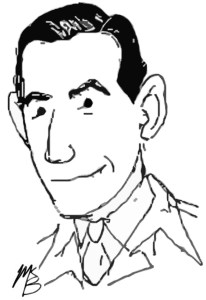
He never hesitated to go where he felt his duty called him and when he flew in some danger in a helicopter to make contact with the local authorities with whom he hoped he might organise a cease fire, but without avail … His Brigade has been completely cheerful and supremely confident and splendidly trained and his own inspiring efforts have shown him to be a leader second to none and in action upholding the very highest tradition of the British Army.”
(D.S.O. Bar, citation, 13 Jun 1957)
Born in Toronto, Ontario on 1 July 1913, Mervyn Andrew Haldane Butler was commissioned in the Prince of Wales’s Volunteers (South Lancashire Regiment) in 1933 after attending Royal Military College, Sandhurst. He served with the 1st Battalion during the Battle of France in 1940 and earned the Military Cross. Under heavy machine gun and mortar fire, he gathered as many soldiers as he could to drive the enemy out of their position. His name appeared in the newspapers again later that year when a British Army major sued his wife for divorce on the grounds of adultery with Butler, who later married the divorcee, Marjorie Millicent Dann, in 1941.
At the end of November 1944, Butler was appointed commanding officer of the 2nd Battalion, Essex Regiment. Colonel T.A. Martin, author of the regimental history, described Butler’s unpretentious introduction to the unit:
He arrived wearing an old jeep coat showing no badges or rank, and quite unknown walked round to judge the form, standing to watch an anti-tank gun crew cleaning their gun. After a few minutes he asked a question to which the N.C.O. replied rather shortly; he still stood there, whereupon Sergeant Jago turned round and said, “Just — will you, as we’re busy cleaning up for the new C.O.,” whereupon Colonel Butler went off without another word.
Butler was impressed with the battalion and counted himself fortunate that they were held in a quiet sector where “I was able to get to know the Battalion and become extremely fond of it.” At the end of January 1945, he was recommended for the Distinguished Service Order:
His complete grasp of the situation and coolness under heavy enemy mortar and small arms fire made a marked impression on the company. On the final day of the operation he planned and executed a raid which led to the withdrawal, with heavy casualties, of forty enemy from a forward position. This raid he personally directed from one of the forward tanks.
Throughout the three days of the operation he displayed such outstanding courage in the close presence of the enemy, such unflagging energy and such tactical skill that his battalion was full of offensive spirit from the start of the operation until the enemy had finally been defeated. His conduct was an inspiration to all who saw him and undoubtedly contributed largely to the success that his battalion achieved.
A captain recalled of Butler’s enthusiastic command style: “He reveled in being up with the forward companies, and on one occasion, when Battalion Headquarters was at Valburg, we visited a forward company and then walked on up the road into no-man’s-land. The country was all flooded around us … Four hundred to five hundred yards out he saw a cat which must have been stranded on a tiny piece of high ground when the Boche flooded the Island. The war was temporarily forgotten, and rafts were floated out to rescue the unfortunate animal. After a few unsuccessful attempts, we managed to rescue the cat and the party then returned back to our own lines” (quoted in T.A. Martin, Essex Regiment, 229).
Butler led the 1st Essex until the end of April when he was posted back to the South Lancashire Regiment in command of the 1st Battalion, prompting one officer to remark, “His departure left a sense of great personal loss to every man in the Battalion.” After the war, Butler transferred to the airborne service and commanded 9th Parachute Battalion from 1946 to 1947. A decade later he commanded the 16th Parachute Brigade, and earned a D.S.O. Bar during the Suez Crisis of 1957. For command of that brigade a year earlier in Cyprus, he was awarded the C.B.E.: “by his personal drive, energy and tenacity had a series of successes with his Brigade against BOKA terrorists. He conducted six major operations, each of which resulted in the killing or capture of leading terrorists and the recovery of considerable quantities of arms and ammunition.”
In addition to further command postings at division and corps levels, Butler served as commandant of the Staff College at Camberley and later commandant of the Royal College of Defence Studies. He went on to be colonel commandant of the Parachute Regiment from 1967 to 1972.
Butler died in Midhurst, Sussex on 3 January 1976.
 World War Graphic History