Lieutenant-Colonel Jack Walford
5th Battalion, Seaforth Highlanders
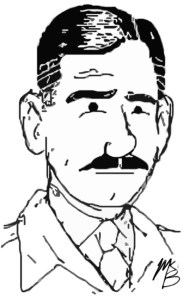
It is the custom in the army for the commander of an infantry battalion to complete an active tour of duty of a limited period, the idea being that if he has been doing his job properly and by some happy chance still remains alive at the end of it, the strain will have been so great that a fresh man should succeed him. Colonel Walford appeared to be made entirely of indiarubber and strong springs he had not been visibly affected by the rigours of leading the Battalion in every action from Alamein to Venlo; but his time was more than up, and he had to go.
(Alastair Borthwick, Sans Peur: The History of the 5th (Caithness and Sutherland), 297)
Born in Kensington, Middlesex on 4 May 1900, John Herbert Walford was commissioned in 1920 and became a lieutenant in the King’s Royal Rifle Corps before joining the Seaforth Highlanders. He was wounded and concussed while fighting during the Battle of France in June 1940. Scottish author Alastair Borthwick who served as intelligence officer with the 5th Battalion, would later write few could have foreseen “that quiet Major Walford was to lead the Battalion with such success in battle after battle that by the end of the war he would be a legend.”
Walford served as second-in-command of the 5th Battalion which was posted to the North African theatre as part of the 152nd Brigade, 51s Division in 1942. Bothwick wrote that compared to Lieutenant-Colonel J.E. (Jumbo) Stirling, “Walford (Juicy to the men), was a less forceful character, with a quiet manner and a habit of taking time to come to the point. He tended to be overshadowed by the colonel.” The second-in-command, however, proved himself a courageous leader during the Second Battle of El Alamein in October/November 1942 and in subsequent actions.
In January 1943, with Stirling promoted to 154th Infantry Brigade, Walford assumed command of the 5th Battalion. For leading an attack that month in “hand-to-hand fighting,” he would earn the D.S.O.:
During this period he was constantly on the move, and under close fire, encouraging his Battalion by his personal example, and bearing and co-ordinating their positions. Some three hours later, the enemy began everywhere to withdraw. The prompt appreciation of the situation by Lieutenant-Colone Walford in the early stages of the battle and his fearless leadership whilst continuously under heavy fire was undoubtedly a considerable factor in forcing this withdrawal.
He led the battalion through to the end of the campaign in North Africa and the invasion of Sicily in July 1943. In October and November, the battalion along with the rest of the 51st Division was recalled to the United Kingdom to prepare for the invasion of France in June 1944. Throughout the Normandy campaign and in the drive into the Low Countries, Walford continued to characteristically reconnoitre well forward of battalion positions by jeep. For actions on 18 July 1944, he earned a D.S.O. Bar:
Lt Col Walford’s planning and organisation of the attack were exemplary in their thoroughness during the whole battle was very largely responsible for the great momentum of the attack from start to finish and for the extremely successful result. He was always in the forefront of battle regardless of personal danger and his drive and initiative was a real inspiration to everyone.
After an extraordinarily long tenure of two years in command, from North Africa to Sicily, from France to the Netherlands, Walford was finally relieved in January 1945. He passed command to Major J.M. Sym, who had twice escaped as a prisoner of war in Italy. Walford was posted to the 9th Battalion, Seaforth Highlanders on reserve duty in Scotland.
Bothwick dedicated his 1946 battalion history to his much-respected former commanding officer:
This is a history, and opinion should have no place in it. Nevertheless I am going to say my say about Jack Walford. I was his Intelligence Officer from DDay onwards, and as I lived with him twenty-four hours a day I reckon I know a certain amount about him. He was tireless and he was thorough. His method of planning drove adjutants to despair, and consisted in worrying and worrying at the facts until he had them arranged to his liking — a process which, in the case of a set-piece attack, might last for days. Where a tidier mind might have reached a quick conclusion, he continued to chew away at the facts, arranging, rearranging, thinking aloud, and in the end arriving at perhaps a different conclusion — the correct one. His set-piece attacks were always watertight.
… The Jocks trusted him implicitly. They used to say: ‘If Juicy says it’s all right, then it’s all right.’
My personal opinion — and it is shared by many other officers who served under him — is that his thoroughness and those unsparing reconnaissances not only got the Battalion on to its objective every time but saved us anything up to five hundred casualties.
Walford died in Oxford on 7 February 1976.
 World War Graphic History