Lieutenant-Colonel Geordie Andrews
2nd Battalion, Seaforth Highlanders
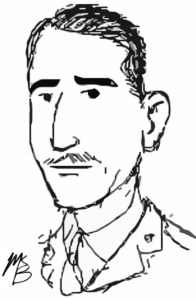
We saw each other at the same moment and, thinking it wise to seize the initiative, I let fly at him with my new Walther. Needless to say, I missed him. I was not too sorry, as I bore the fellow no particular malice—at least I had joined that surprisingly small circle of officers who had actually fired their pistols in anger.
(Quoted in Andrew Todd, The Elephant at War, 102)
Born in Cockermouth, Cumberland on 1 July 1910, George Lewis Williams Andrews was a graduate of Haileybury College and Royal Military College, Sandhurst. He was commissioned into the Seaforth Highlanders in 1929, and served with the 1st Battalion in Palestine in the 1930s. After the outbreak of the Second World War, he served on staff with 17th Infantry Brigade headquarters and completed staff college.
Posted to Egypt and the North Africa theatre, Andrews became second-in-command of the 5th Battalion in February 1943. After a battle in early April, he noted “It was common for a Second-in-Command to be left out of an attack in case the C.O. should be hit, and it occurred to me later that this was probable in my case; but at the time I sourly felt that I was just becoming the brigade odd-job man.”
Shortly after the 51st Division landed in Sicily, Andrews took over the badly depleted 2nd Battalion, Seaforths. On 19/20 July 1943, the Germans had captured CO Lieutenant-Colonel Rory Horne, 2iC Major John Sym, two company commanders, the intelligence officer, and a platoon. Although Sym would soon escape he was recaptured and taken to Rome while Horne was imprisoned in Germany.
Andrews narrowly avoided capture himself when he his jeep crossed behind enemy lines on 2 August. Coming upon a German halftrack crew, he recalled, “Seeing me, they waved in a friendly manner — I have no idea who they thought I was.” After another British jeep then opened fire on the enemy, the colonel recalled:
Almost at once, there was bedlam as firing broke out all round us. It was clear we had motored casually into the enemy lines. It was a mystery why they had let us do so without opening fire until we did — it was certainly not a planned ambush, but they may have thought we were Germans driving captured vehicles.
Andrews, his driver, and another soldier attempted to escape on foot but the other two were captured. Removing his rank badges to make a less tempting captive, Andrews wandered in the brush until recovered by a Black Watch patrol. The next day, he returned to the site to get his abandoned jeep.
In October and November, the battalion along with the rest 51st Division were withdrawn from the Italian theatre to the United Kingdom in order to prepare for the invasion of France. Andrews led the 5th Battalion ashore at Normandy on D-Day +1. He went on to earn the O.B.E. and the D.S.O. for leadership during the campaign in the Netherlands and Ardennes:
On several occasions when the fighting was heavy and confused, the leading companies were lost in thick woods. Lt Col Andrews, with complete disregard of his own safety, immediately went to find them and lead them on their way. Wherever the fight was hottest he was there to encourage and lead …
Following temporary command of the 152nd Infantry Brigade and a final operation with the battalion in February, he left to be GSO I with 21 Army Group headquarters. Lieutenant-Colonel George Dunn of the Black Watch took over the 2nd Seaforths.
After a long postwar army career that included postings to the United States, Libya, Egypt, and Scotland, Andrews was appointed assistant commandant at Sandhurst. He retired at the rank of brigadier in 1960 and became honorary colonel of the 2nd Battalion, 51st Highland Volunteers in 1970.
Andrews died on 27 August 2001 at the age of ninety-one.
 World War Graphic History