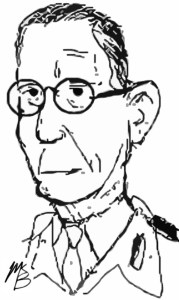
Colonel Franciszek Skibiński
3rd Rifle Brigade
10th Armored Cavalry Brigade
Well, just the liberation of the concentration camp—well, it was a discovery [of] Papenburg. It was the first camp I saw in my life. I heard the stories about how this camp were [sic] looking. But to see heaps of terribly lean naked bodies lying … Well, it was a very shocking sight. And it shocked me and my soldiers, as well, very, very deeply. I do remember this moment.
(Interview, October 1981, https://collections.ushmm.org/search/catalog/irn513325)
Born on 15 August 1899 in Munich, Germany, Franciszek Maria Maksymilian Skibiński served with the Puławy Legion during the First World War and joined the secret Polish Military Organization in 1918. He served with the Polish Army during the wars of independence and was commissioned a second lieutenant in 1920. Although reprimanded by an officers’ court of honour for an incident of disturbing the peace in 1925 and arrested for firing a gun allegedly while intoxicated in 1927, he continued to advance through the ranks, rising to a major by the September 1939 campaign.
After the German and Soviet invasions, Skibiński escaped with his brigade to France via Hungary. After the German occupation of France, he escaped again via Spain and Portugal to the United Kingdom. He had served as chief of staff with 10th Armored Cavalry Brigade under General Stanislaw Maczek in the Battle of France and then became deputy commander of the formation in Normandy. He succeeded Colonel Marian Wieroński of 3rd Rifle Brigade at the end of August. Awarded the Distinguished Service Order for leadership in the Scheldt campaign, the citation read in part:
During this action Col. SKIBINSKI exhibited great courage and ability, commanding personally from his tank amongst the forward troops.
On 7 and 8 Nov 44 during hard fighting for the MOERDIJK bridge head, he was an inspiring example to the Brigade which was battling under exceedingly trying and difficult conditions and subject to continuous and heavy enemy fire from mortars and artillery and it was largely due to his untiring efficiency that a successful conclusion was reached.
In both these actions and throughout the whole campaign in North West Europe, Col. Skibinski has displayed outstanding bravery and great power of endurance and leadership, and has been a magnificent Brigade Commander in every respect.
He returned to 10th Armored Cavalry Brigade in January 1945, succeeding Colonel Tadeusz Majewski. During the final push into Germany, his brigade liberated concentration camps and a POW camp holding Polish woman and girls from the Warsaw Uprising:
And they were absolutely amazed when they saw that they are liberated not by the Americans, not by the Englishman, not by the Canadians, but just it happens so that the Polish division came to liberate their camps. Many soldiers, our soldiers, met over there. They had relations with and acquaintances and so on. And with this camp, I must confess, we took care of much, much, much more than in other camps, which is quite understandable. We found our own people.
Unlike many Polish officers, after the war, Skibinski returned to his home country now under Soviet occupation and communist rule. In 1952, he was accused of participating in a military conspiracy against the government and sentenced to death for treason. The execution was commuted, but he remained in prison until the charges were dropped in 1956. Rehabilitated, he was promoted to brigadier general in 1958 in the Polish People’s Army and headed the Ministry of National Defense Studies Office until 1964. He also completed a doctorate in military science with a dissertation on the Battle of Normandy.
He was made a major general in 1988 and died in Warsaw on 16 May 1990.
 World War Graphic History