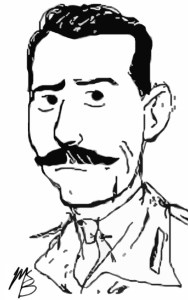
Lieutenant-Colonel Zdzislaw Szydłowski
9th Flemish Rifle Battalion (Poland)
My father, who finally was in command at Maczuga, told me of the feelings of the men. They were not beaten, but they were in a serious position. I have the impression that General Maczek was surprised they hung on, but they would not give up. The Polish soldiers were happy to meet the Canadians on that hill. The biggest emotion was relief and also it was pride that the cork stayed. That was the impact of the whole action. Pride overruled fear.
(Chris Szydłowski quoted in Whitaker, Normandy, 293)
Born on 21 September 1900 in Lwów, Poland, Zdzisław Mateusz Lubicz-Szydłowski was a soldier and scientist, having received a doctorate in biology from Poznair University in 1928. After Poland’s independence in November 1918, he served in the army during the Polish-Ukrainian War then the Polish-Soviet War and took a commission in 1923. In 1929, he had a duel with fellow officer and medical doctor Alojzy Pawelek. The next year, Szydłowski shot and killed Pawelek in his office after a violent argument. Szydłowski was arrested and briefly imprisoned but resumed his military career.
Following the invasion of Poland in September, Szydlowski escaped to France where he joined the underground resistance after the German occupation. He fled to the United Kingdom in 1942 and trained with a parachute brigade. In November 1943, he was appointed commanding officer of 9th Rifle Regiment, which deployed to France in July 1944. He earned the D.S.O. for leadership and courage during the Falaise Pocket:
On August, 19th, 20th, 21st, 1944, the situation in the hills north of Chambois became temporarily critical owing to a local breakthrough of enemy armour, which resulted in troops on these hills, 2nd Polish Armd Regt, 9th Polish Inf Bn and 1 A/Tk Bty, being cut off from the main body of the Division and from supplies. Strong enemy attacks followed with armour and artillery, both from the east and west. Lt Col Szydłowski, by seniority, took command of the whole group. Owing to his personal courage, example and coolness, the critical situation has been overcome, enemy attacks beaten off and the task of the Division performed.
He relinquished command to Major Konrad Stępień in January 1945. Stępień led the battalion through to the end of the war but was killed in a traffic accident in Germany on 16 May 1945. After demobilization, Szydłowski moved to Canada where he resumed work in biology research and teaching. He died in Toronto on 3 October 1973.
 World War Graphic History