Lieutenant-Colonel Peter Barclay
4th Battalion, Lincolnshire Regiment
1st Battalion, Royal Norfolk Regiment
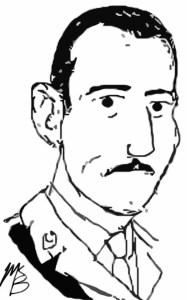
It was absolutely wonderful and a thrilling feeling to experience the spirit of the chaps who are with you—it is intangible—but its the most exhilarating, potent influence. It revives you, you can never feel tired, you never feel depressed when you have a spirit round you like the spirit we enjoyed. And the whole thing was treated as a jolly-well, worthwhile job that has to be done.
(Barclay, interview, 21 May 1984) https://www.iwm.org.uk/collections/item/object/80007993
Born in Cromer, Norfolk, England on 8 March 1909, Francis Peter Barclay was commissioned with the Norfolk Regiment in 1929 after attending Twyford School and Royal Military College, Sandhurst. Of his decision to join the army, he explained decades later, “I thought it was a wonderful life … and I never regret it from that day to this.” After service in India, he was posted with the 2nd Battalion to Gibraltar just before the outbreak of the war. He served as company commander when the battalions went to France in September 1939. He received the Military Cross for leading a three-man patrol into enemy lines on the night on 3/4 January 1940.
This was the first decorations awarded to an officer in the campaign, and the engagement was one of the earliest hostile actions between British and German troops on the Western Front months before the invasion of France in May 1940. As much of the Allied force retreated for the evacuation at Dunkirk, the 2nd Norfolks held a defensive line against the advancing German forces. Witnessing his battalion commander break down, Barclay reflected in an interview: “It’s a most difficult thing I suppose to really assess how a person is going to react in wartime when you’ve only got your peacetime experience to work on.”
Later in the battle, after successfully ambushing SS troops, Barclay’s company came under “an inordinate amount of shelling and mortar fire. Not so long after, I was wounded in the guts, back and arm.” Intent on continuing to direct the action despite the wounds, Barclay explained:
My batman with great presence of mind, ripped a door off it’s hinges and in spite of my orders to the contrary, tied me on to this door. In fact, had he not done this I probably wouldn’t be here to tell the tale. But there I was tied to this door and I thought: ‘Right you’ve got to take me around on this door … of course that took four people. So they took me around on this door to deal with what had become a very threatening situation from our right flank.
Barclay eventually passed out and was evacuated back to the United Kingdom. He married in October 1940. He ran a battle training school until April 1944, when he took command of the 4th Battalion, Lincolnshire Regiment, which landed in France with the rest of 49th Division in mid-June. By the end of the month, Barclay earned the D.S.O.:
As a result of good and careful planning and excellent leadership, the Bn fought its way through 3 lines of Boche defences with great skill and reached its allotted objectives …
It was due to the skill, leadership and personal example of Lt Col BARCLAY, who showed a complete disregard of personal danger, that this success was achieved. Since this attack, by his personal drive and leadership, Lt Col BARCLAY and his Bn have continued to dominate the enemy and have caused him considerable casualties.
By February 1945, he had transferred back to the Norfolk Regiment to take command of the 1st Battalion. He remained in the postwar army with postings in Germany, Britain and Canada. He became commander of 46th Parachute Brigade in 1953 and then headed physical training with the War Office in 1955. He retired from the army in 1961.
Barclay died in his Norfolk home on 13 October 1992.
 World War Graphic History