Lieutenant-Colonel Aleksander Nowaczyński
8th Rifle Battalion (Poland)
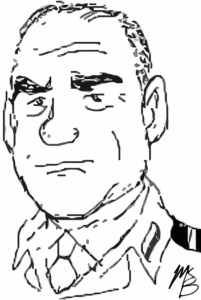
On the top of Hill 262 stands Lieut. Col Nowaczynski, the battalion commander, with the commander of the Canadian tanks, staring in silence at the battlefield. Over the khaki uniforms, at the emerald-blue lance pennons of the dead soldiers of the 8th Battalion, the disfigured faces, jutting jaws and teeth in deathly smiles, human parts — torsos, legs, bloodied stretchers, pieces of an anti-tank gun, and nearby a barrel of a broken mortar in the convulsive grip of a dead gunner. In the middle of a few blackened, smoking Shermans, on their turrets hangs a leaning torso, half scorched hands lying listlessly.
(Quoted in Halik Kochanski, The Eagle Unbowed, 484)
Born on 24 November 1900 in Urzędów, Aleksander Nowaczyński was active in the nationalist secret Polish Military Organization and witnessed the emergence of an independent Poland in November 1918 at the end of the First World War. He joined the newly created Polish Army and participated in the Polish–Ukrainian War then the Polish-Soviet War. He was commissioned a lieutenant in 1923 and by September 1939 was a major. He organized evacuation to Romania during the Soviet invasion of eastern Poland.
Following internment, he made it to France via the Balkans. After the German invasion of Western Europe, he evacuated to the United Kingdom and trained with a parachute brigade. Following an appointment to the 3rd Parachute Battalion, Nowaczyński became commanding officer of the 8th Rifle Battalion in December 1943 and was promoted to lieutenant-colonel in March. The unit deployed to France in July as part of 3rd Infantry Brigade, 1st Armoured Division under the overall command of General Stanisław Maczek.
Preparing for the eventual invasion of the continent, Maczek praised his three appointed infantry battalion commanders:
I gratefully took 3 officers of the parachute brigade as commanders, who due to their age were not assigned to paratroopers, namely: Lieutenant Colonel Z. Szydłowski, Lieutenant Colonel Complak and Lieutenant Colonel Nowaczyński, who performed miracles in a short time, creating units of transported infantry that were in every respect subordinate. It is all the more worth emphasizing that they could not choose among people, accepting everything that came to the unit, and even then it did not fill 100 percent of the positions.
Attached to II Canadian Corps, the division went into action at Caen in early August 1944. Through the hard, brutal fighting to close the Falaise Gap, the 8th Rifle Battalion earned the nickname “Bloody Shirts,” and Maczek recalled of one junior officer:
I can still see his disappointed face when I refused to call his battalion ‘the Bloody Shirts,’ as it had been dubbed after the battle of the ‘Mace,’ when their lightly wounded commander, Lieutenant Colonel Nowaczynski, was indeed plentifully covered with his own blood. The name, however, was not officially approved.
(Quoted in Jenny Grant, Price of Victory, 2024, 211)
Nowaczyński would go on to receive the D.S.O. for heroic leadership in April 1945:
Showing total disregard for danger and ignoring the enemy fire, he led his men with courage and dash, and was an inspiration to all.
In the final stage of the attack, Lt-Col. Nowaczynski at the head of his two leading companies, stormed the enemy’s position and with a few of his men was the first to reach the final objective.
His men of C. and D. Company seeing their Battalion Commander among them while attacking the enemy’s positions, all the time subject to heavy enemy fire, went forward and stormed the strongly defended enemy positions with great determination in the shortest time, inflicting heavy casualties.
Throughout, the action Lt-Col. Nowaczynski set a magnificent example of devotion to duty and outstanding bravery in the field of battle, and he was instrumental in bringing the operation to a successful conclusion.
Unlike many Polish officers, Nowaczyński returned to his home country, by then under Soviet occupation and communist rule. He died in 1990.
 World War Graphic History